

Forget the crowded gym and expensive memberships. Building a powerful chest at home is more achievable now than ever before, thanks to a fantastic range of equipment designed to fit your space, budget, and fitness goals.
You don't need a massive, commercial-style machine to get serious results. A smart combination of free weights, bands, and other specialized tools can get the job done right in your living room or garage.
Why Your Home Gym Is the New Fitness Frontier
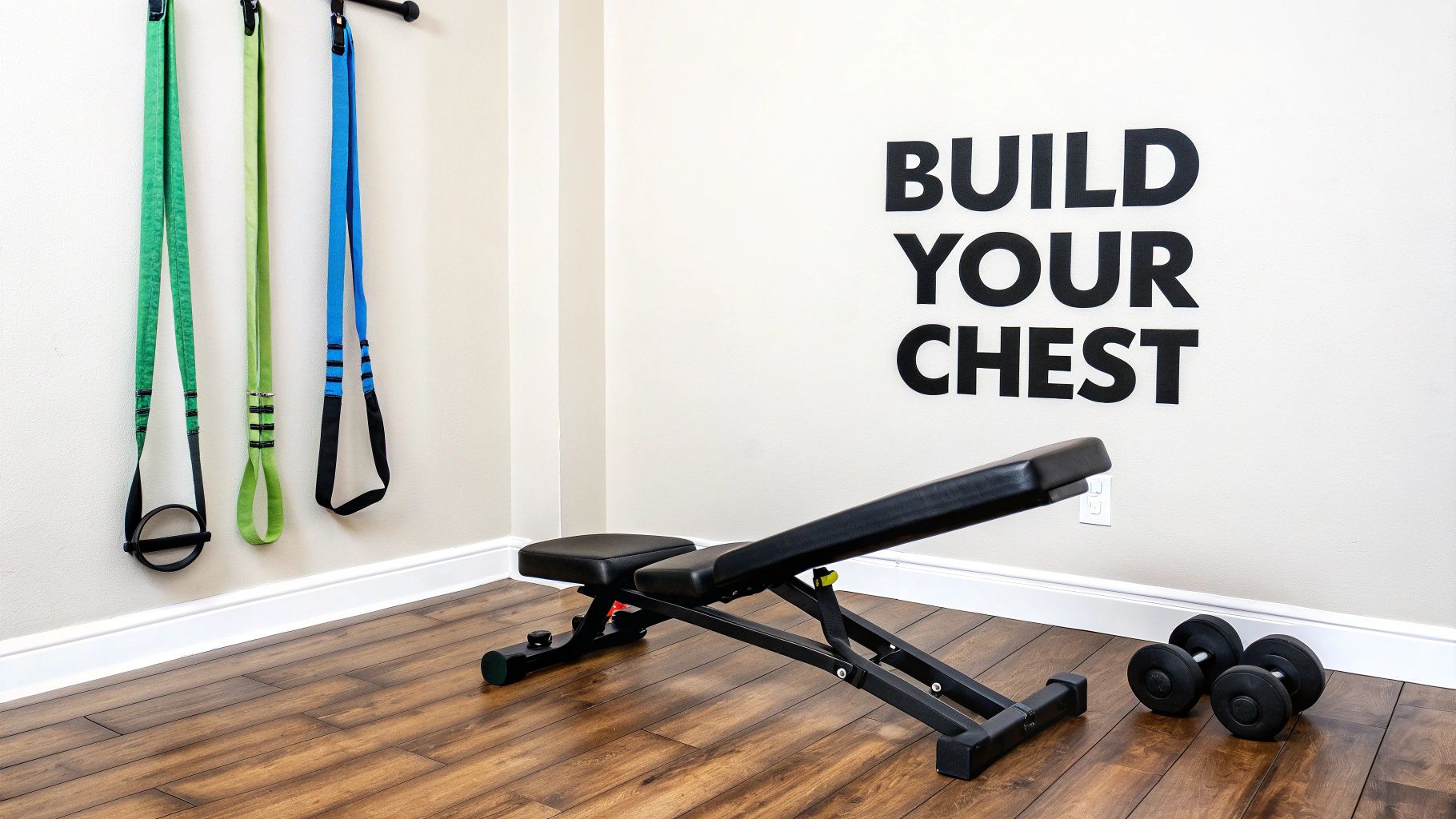
Ready to build a stronger chest without ever leaving the house? The great news is you don't need a membership card to see incredible progress. This guide is here to cut through the noise and help you pick the perfect gear for your goals, space, and wallet.
The move toward home fitness isn't just a temporary fad—it's a massive shift in how we think about working out. People are loving the convenience and control of creating their own personal fitness spaces. In fact, the at-home fitness market is projected to skyrocket to around $20.56 billion as more and more people invest in their setups. You can dive deeper into the at-home fitness equipment market trends to see just how big this movement has become.
Your Path to a Stronger Chest Starts Here
This guide will walk you through everything, from classic free weights that are perfect for packing on muscle to versatile resistance bands that fit into the smallest apartments. We’ll break down the good, the bad, and the practical for the most effective chest workout equipment for home, so you can make a choice you feel great about.
Before we get into the nitty-gritty of each item, let's start with a bird's-eye view.
The secret to a successful home gym isn’t about having the most expensive equipment. It’s about choosing gear that fits your life. A high-end machine is useless if it just collects dust, but a simple set of dumbbells or bands can deliver amazing results if you actually use them.
To kick things off, the table below gives you a quick snapshot of your main options. It’s designed to help you immediately spot what might work best for you, so you can start planning your ideal chest-building sanctuary today.
Home Chest Equipment At a Glance
Here’s a quick comparison of popular home chest workout equipment to help you find the best starting point for your goals.
| Equipment Type | Best For | Space Required | Price Range |
|---|---|---|---|
| Dumbbells | All-around strength, muscle mass, and stability | Small to Medium | $50 - $500+ |
| Adjustable Bench | Versatility, proper form, and maximizing dumbbell exercises | Medium | $100 - $400 |
| Resistance Bands | Beginners, warm-ups, and limited-space workouts | Minimal | $20 - $70 |
| Chest Fly Devices | Isolating the chest muscles for a defined look | Small | $40 - $100 |
| Hydraulic Exercisers | Controlled resistance and joint-friendly workouts | Minimal | $50 - $150 |
This table is just the beginning. Our goal is to give you all the info you need to create a setup that’s perfectly tailored to you, making it easier than ever to stay consistent and crush your fitness goals.
Why Free Weights Are the Gold Standard for Chest Growth
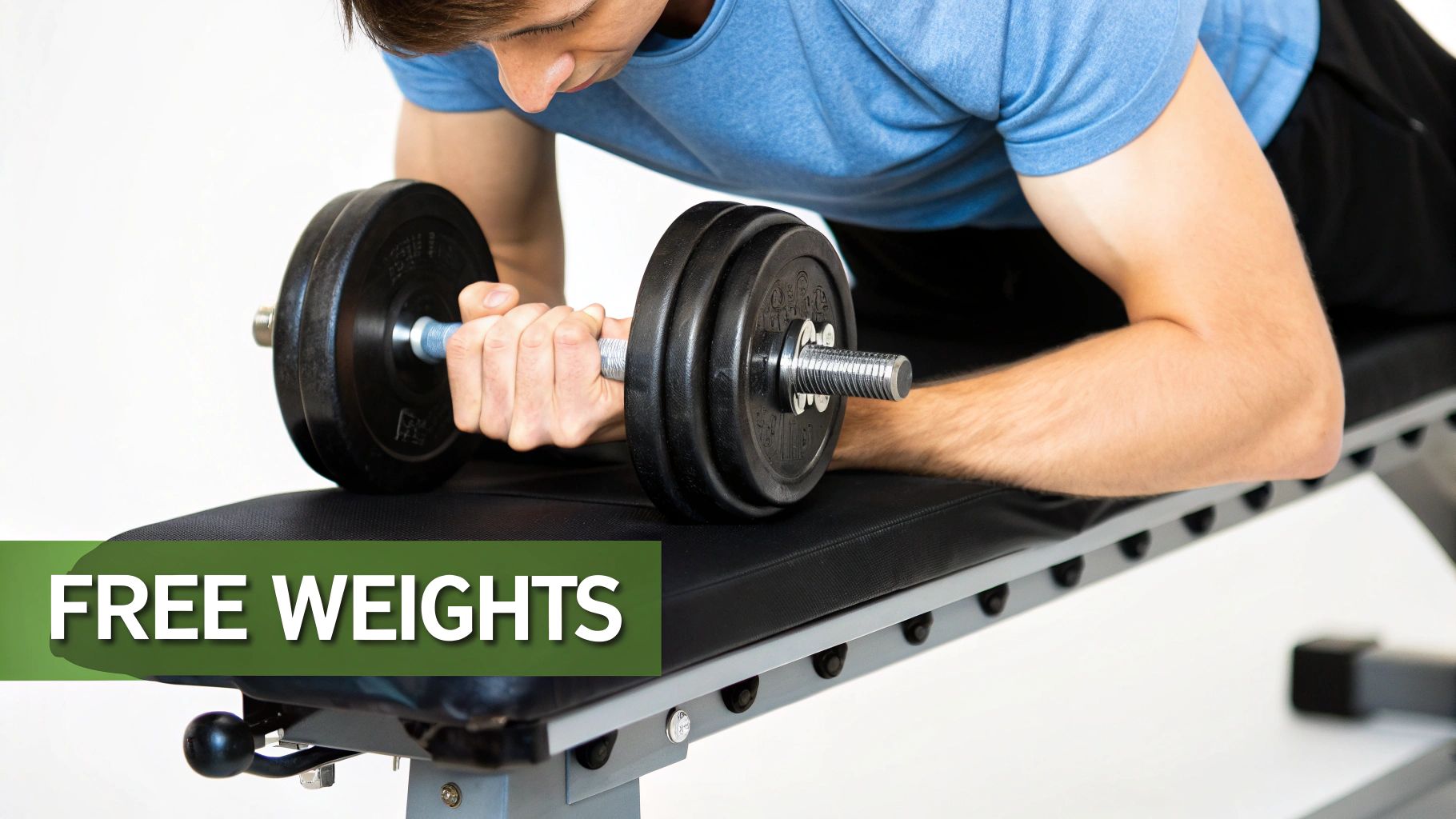
When you imagine building a powerful chest, what’s the first thing that pops into your head? For most of us, it’s the classic image of someone pressing a heavy set of dumbbells. There’s a good reason for that—when it comes to packing on raw strength and muscle, nothing beats the combination of dumbbells and an adjustable bench. They are, without a doubt, the undisputed champions of chest workout equipment for home.
Unlike a machine that locks you into a fixed path, free weights make your body work harder. They demand balance and control, firing up all those smaller, stabilizing muscles that machines tend to ignore.
Think of it this way: a chest press machine is like riding a train on a track. It gets you where you're going, but the path is set. Dumbbells, on the other hand, are like off-roading. You're in total control, but you have to steer, stabilize, and react to stay on course. All that extra effort is what builds real, functional strength.
The Power of Dumbbells in Unlocking Growth
Dumbbells are the foundation of any effective home gym. They allow a more natural arc of motion, which is much kinder to your joints than a rigid barbell. This freedom also lets you get a deeper stretch at the bottom of a press or fly, which means you recruit more muscle fibers. More fibers working equals more growth.
The market backs this up. The global strength training equipment market is a massive $12.96 billion industry, and free weights make up the biggest slice of the pie at around 43.55%. That tells you just how essential they are for anyone serious about getting stronger, especially at home. You can dig into the numbers yourself in this global strength training equipment market report.
Another huge benefit is that dumbbells force each side of your body to pull its own weight. This is a game-changer for fixing muscle imbalances. If your left pec is weaker than your right, you’ll know it immediately—something a barbell can easily hide.
Fixed vs. Adjustable Dumbbells: The Great Debate
When it's time to choose your dumbbells, you've got two main paths to go down.
-
Fixed Dumbbells: These are the classic, single-weight dumbbells you see lining the racks at a commercial gym. They're built like tanks and are super convenient for quickly grabbing the next weight you need. The downside? A full set takes up a ton of space and can cost a small fortune.
-
Adjustable Dumbbells: These are the superheroes of home fitness. A single pair can replace an entire rack of fixed weights, letting you change the load with a quick click or turn of a dial. For anyone working with limited space, they’re an incredible investment, giving you a huge weight range in a tiny footprint.
For most people building a home gym, adjustable dumbbells just make sense. They deliver the best bang for your buck in terms of function, space, and cost.
The Adjustable Bench: Your Workout Multiplier
If dumbbells are the engine, the adjustable bench is the transmission. This one piece of gear completely transforms your workouts, letting you hit every single fiber in your pecs from every conceivable angle.
A flat bench is good. An adjustable bench is great. By simply changing the angle, you can shift the focus of an exercise to different parts of your chest.
An adjustable bench turns one exercise—the dumbbell press—into three completely different movements. It's the secret to building a well-rounded, fully developed chest because it lets you target specific areas with absolute precision.
Here's a quick breakdown of how the angles work:
-
Incline Position: Set the bench to a 30-45 degree angle, and you'll put more stress on the upper (clavicular) head of your pecs. This is what builds that full, "shelf-like" look at the top of your chest.
-
Flat Position: This is your standard bench press position. It’s the go-to for building overall mass and power right through the middle of your chest.
-
Decline Position: Angling the bench downward hones in on the lower portion of your pecs. Too many people neglect this area, but it’s essential for creating that sharp, defined line at the bottom of your chest.
Without an adjustable bench, you’re basically doing chest day with one hand tied behind your back. It’s the piece of chest workout equipment for home that unlocks the true potential of your dumbbells.
Starting Your Free Weight Journey
Ready to get to work? With just a set of dumbbells and an adjustable bench, you have everything you need for the most effective chest-building exercises out there.
-
Dumbbell Bench Press (Incline, Flat, Decline): This is the king. It’s a compound movement that lets you move serious weight to build a solid foundation of size and strength across your entire chest.
-
Dumbbell Flyes: This is an isolation move that’s perfect for stretching the chest muscles to promote width. It helps create that broad, powerful look by hitting the outer pecs hard.
-
Dumbbell Pullovers: A true old-school classic. This exercise hits the chest, lats, and serratus anterior, helping to expand your rib cage and improve your entire upper-body aesthetic.
So, where do you start with weight? Simple. Pick a weight you can lift for 8-12 reps with perfect form. The last couple of reps should be a real challenge, but not so hard that your form breaks down. It's always smarter to start light and master the movement before you go heavier. That's the key to staying safe and getting the best results.
Powerful Results in Small Spaces
Not everyone has a spare room or a garage they can turn into a full-scale home gym. If the thought of squeezing in a weight rack and bench feels downright impossible, don't sweat it. You can still build an impressive chest with some of the most effective, space-saving, and affordable chest workout equipment for home.
These tools are proof you don't need a massive footprint to make a massive impact. Living in a smaller space just forces you to be smarter with your gear. Forget the big, bulky machines. The focus shifts to versatile equipment you can tuck away in a closet, slide under a bed, or stash in a corner. This is where tools like resistance bands, push-up bars, and portable chest exercisers really shine.
The Magic of Resistance Bands
Resistance bands are, without a doubt, the most versatile and portable piece of fitness gear you can own. Think of them as your personal, pocket-sized cable machine. But unlike free weights, which give you the same resistance from gravity on the way up and down, bands offer something unique: progressive resistance.
What that means is the tension increases the more you stretch the band. At the start of a chest press, the resistance is light. As you push forward and extend your arms, the band fights you more and more, hitting peak tension right when your muscles are squeezing the hardest. This constant, building tension forces your muscles to work through the entire range of motion, creating an incredible pump and hitting muscle fibers in a way weights just can't.
Choosing Your Bands
Not all bands are created equal, and for chest, you'll want to focus on a few key types:
- Tube Bands with Handles: These are fantastic for mimicking classic gym moves like chest presses and cable crossovers. The handles give you a solid, comfortable grip so you can focus on the movement.
- Large Loop Bands (Power Bands): These are the heavy-hitters—thick, continuous loops of rubber. They're perfect for adding a challenge to bodyweight exercises. Just wrap one around your back for a band-resisted push-up and feel the difference.
- Figure-8 Bands: While often used for upper back and arm exercises, they're surprisingly effective for certain chest isolation movements to really target specific areas.
The real power of resistance bands isn't just that you can take them anywhere. It's their ability to keep tension on the muscle through the entire exercise. This "time under tension" is a key driver for muscle growth, forcing your chest to adapt and get stronger.
Elevate Your Push-Up Game
The push-up is the undisputed king of bodyweight chest exercises. But you can make it even better with a simple, inexpensive tool: push-up bars. These little handles might not look like much, but they give you two huge advantages.
First, they give you a deeper range of motion. By lifting your hands off the floor, you can lower your chest further, creating a much greater stretch in your pecs. A deeper stretch under load is a proven way to activate more muscle fibers and spark new growth. Second, they put your wrists in a more neutral, comfortable position, which reduces the strain that can come from doing push-ups with flat palms. This makes the exercise safer and something you can stick with long-term.
Innovative Tools for Chest Isolation
Beyond bands and bars, a new category of portable chest workout equipment for home has popped up, designed specifically to isolate the pecs without a huge machine. You’ll see them called portable chest fly machines or hydraulic chest exercisers.
These gadgets usually have two handles connected by a resistance unit, often using hydraulics or powerful springs. When you squeeze the handles together, you’re perfectly mimicking the motion of a pec-deck or cable fly. This puts direct, targeted stress on your inner chest muscles. They’re compact, adjustable, and perfect for burning out your chest at the end of a workout to make sure you’ve hit every last muscle fiber.
Of course, if you have a little more room to play with, combining these tools with some free weights is a game-changer. For a great space-saving option, check out our 3-in-1 Quick Adjustable Dumbbell Weight Set, which packs the power of multiple dumbbells into one compact design.
Building a Routine with Minimalist Gear
Putting it all together is simple. You can create a killer chest workout using only these compact tools by combining compound movements with isolation exercises to hit your chest from all angles.
Here’s a sample workout you can try:
- Compound Movement: Band-Resisted Push-Ups (3 sets to failure) - This blasts your entire chest, plus your shoulders and triceps.
- Isolation Movement: Standing Band Chest Press (3 sets of 15-20 reps) - This really lets you focus on squeezing the pecs.
- Fly Movement: Band Crossovers (3 sets of 15-20 reps) - Anchor a band to a door and perform a fly motion to carve out that inner chest.
- Finisher: Push-Ups with Bars (2 sets to failure) - Use the bars to get that deep stretch and completely finish off the muscle.
This just goes to show that with a little creativity and the right gear, you can build a powerful chest without a room full of heavy equipment. Smart, versatile tools can deliver a fantastic workout and serious results, even in the smallest of spaces.
How to Choose the Right Chest Equipment for You
Picking the right chest workout equipment for home isn't about grabbing the most expensive or complicated machine you can find. It’s a strategic choice, one that really comes down to three things: what you want to achieve, how much you can spend, and the space you’re working with.
Get this part right, and you’ll end up with gear you actually look forward to using—no buyer's remorse, just faster results.
So, let's start with the big question: what’s your goal? Are you chasing pure muscle size, looking to build that classic, sculpted physique? Or is your focus more on functional strength that helps you in everyday life and other sports? Nailing this down is step one.
Aligning Equipment with Your Goals
Your main goal really dictates the best tools for the job. Someone focused on hypertrophy—that’s just a fancy word for muscle growth—is going to get the most bang for their buck with equipment that allows for progressive overload. Think adjustable dumbbells and a solid bench. That combo is the gold standard for classic muscle-building moves.
On the flip side, if you're all about building functional, real-world strength, you might find that resistance bands or a hydraulic chest exerciser are a much better fit. These tools are fantastic for building durable strength that translates outside the gym, and they're often a bit kinder on the joints.
To help you visualize the best path, this decision tree cuts straight to the chase.
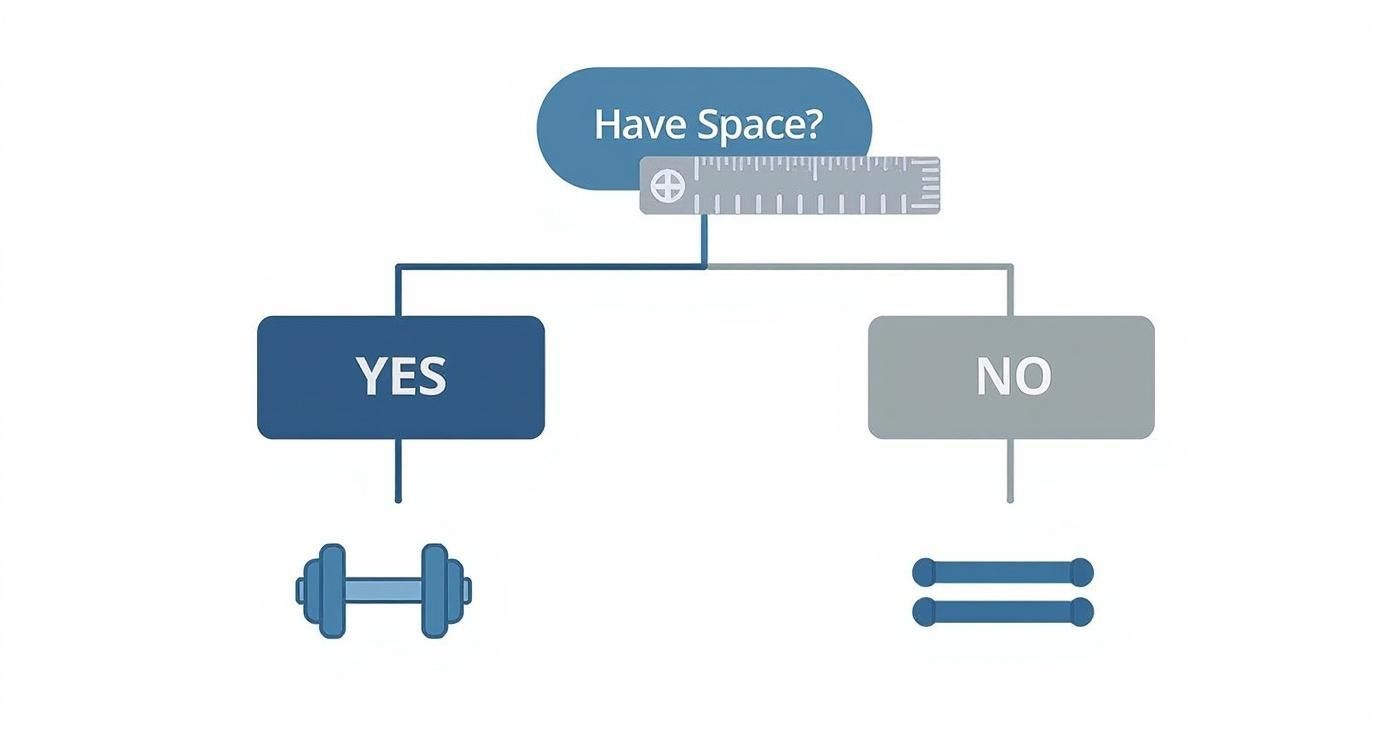
This little guide simplifies things immediately, pointing you toward the gear that makes the most sense for your living situation.
Factoring in Your Budget and Space
Okay, let's talk money and space. The home fitness scene is absolutely booming. In the U.S. alone, the market is projected to hit around $4.07 billion, all thanks to people like you wanting convenient setups at home. The good news? All that growth means there are solid options at every single price point. You can read more about the home fitness equipment market growth to see how things are evolving.
Here's a rough breakdown of what your budget can get you:
- Under $100: You can put together a surprisingly effective minimalist gym. A quality set of resistance bands paired with some sturdy push-up bars is more than enough to get started. Perfect for beginners or anyone on a tight budget.
- $100 - $500: This is where your options really open up. In this range, you could snag a durable adjustable bench and a starter set of dumbbells, or even a high-quality hydraulic exerciser. For a versatile piece that forms the foundation of a great home gym, our Multi-Functional Weight Bench is a killer choice that supports dozens of exercises.
- $500+: Now you're in the big leagues. At this price point, you can invest in a premium set of adjustable dumbbells and a top-tier bench. This creates a complete free-weight station that can give you a chest workout just as good as anything you'd find in a commercial gym.
Last but not least, measure your space. Seriously, grab a tape measure before you hit that "buy" button. Make sure you have enough room not just for the equipment to sit, but for you to move around it safely. An adjustable bench, for instance, really needs about a 7x7 foot area to use it properly with dumbbells without knocking over a lamp.
Making the right choice is a balance of ambition and reality. Choose equipment that fits the life you have now, not the one you hope to have someday. A simple set of bands used consistently will always beat an expensive machine that becomes a laundry rack.
Actionable Workout Routines for Your Home Gym
Owning the right chest workout equipment for home is a great start, but a solid plan is what really turns that gear into results. When you know exactly what to do the moment you step into your workout space, you eliminate the guesswork and can focus purely on your goal—building a stronger chest.
To help you get started right away, we’ve put together three different workout routines. Each one is designed for a specific equipment setup, from the bare essentials to a more complete home gym. Think of these as your go-to blueprints for chest day.
Feel free to bookmark, screenshot, or share these routines. Just find the one that matches your current setup, and you can start building a more powerful chest today.
The Minimalist Routine: Resistance Bands
This workout is all the proof you need that you don't need a mountain of gear to get an incredible chest pump. Using only resistance bands, this routine is all about high volume and constant tension to kickstart muscle growth. It’s perfect for apartments, travel, or anyone just getting their fitness journey started.
- Band-Resisted Push-Ups: 3 sets to failure (Rest 60 sec)
- Standing Band Chest Press: 3 sets of 15-20 reps (Rest 60 sec)
- Band Chest Flyes: 3 sets of 15-20 reps (Rest 60 sec)
- Band Crossovers (High-to-Low): 2 sets of 20 reps (Rest 45 sec)
Pro-Tip: Really focus on the squeeze. At the peak of each rep, pause for a beat and consciously contract your chest muscles before slowly returning to the start. That "time under tension" is your best friend when you're working with bands.
The Foundation Builder Routine: Dumbbells and Bench
If you've got dumbbells and an adjustable bench, you're holding the gold standard for building chest mass at home. This classic routine hits the upper, middle, and lower pectorals for balanced, well-rounded development. It's the perfect next step for anyone serious about adding size and strength.
Having a structured workout is essential. Just as a chef follows a recipe, a lifter should follow a plan. This routine provides the exact ingredients you need for consistent chest growth, taking the uncertainty out of your training.
For a deeper dive into targeting your pecs, you can learn more about how to build chest muscles at home in our detailed article. The workout below is a fantastic place to apply those principles.
Here’s your dumbbell and bench workout plan, laid out for total clarity.
Dumbbell & Bench Chest Workout Routine
This routine is designed to hit all areas of the chest using a foundational free-weight setup. Focus on form and controlling the weight through every repetition.
| Exercise | Sets | Reps | Rest |
|---|---|---|---|
| Incline Dumbbell Press | 3 | 8-12 | 90 sec |
| Flat Dumbbell Press | 3 | 8-12 | 90 sec |
| Incline Dumbbell Fly | 3 | 10-15 | 60 sec |
| Dumbbell Pullover | 2 | 10-15 | 60 sec |
After completing this workout, make sure to cool down with some light stretching to aid recovery.
Pro-Tip: Control the negative. On every single press and fly, take at least 2-3 seconds to lower the weight. This eccentric phase is where significant muscle damage (the good kind!) happens, which leads to more growth.
The Ultimate Chest Day Routine: Full Home Gym
This one is for those who have put together a more versatile home gym, combining free weights with other tools like bands or push-up bars. It mixes different training principles to shock your muscles and trigger maximum growth by hitting them from every angle with varying resistance.
- Primary Strength: Flat Dumbbell Press (4 sets of 6-10 reps, rest 90 sec)
- Upper Chest Focus: Incline Dumbbell Press (3 sets of 8-12 reps, rest 75 sec)
- Isolation and Stretch: Flat Bench Dumbbell Flyes (3 sets of 12-15 reps, rest 60 sec)
- Finisher (Mechanical Drop Set): Push-Ups to failure, immediately followed by Band-Resisted Push-Ups to failure. (Complete 2 rounds, rest 60 sec)
Pro-Tip: For the finisher, the goal is total muscle exhaustion. Perform as many standard push-ups as you can with perfect form, then immediately loop a resistance band around your back and crank out more reps until you physically can't do another one. This kind of overload is a powerful stimulus for growth.
Safety Setup and Equipment Care
Getting your hands on the right chest workout equipment for home is a huge first step. But turning that gear into real results means creating a space that’s safe and keeping your equipment in top shape. Think of it like a pro’s workshop—proper setup and tool care aren't just suggestions; they’re essential for getting the job done right and avoiding injury.
Before you even think about your first rep, carve out a dedicated zone. Make sure your adjustable bench is on a flat, totally stable surface. No wobbles allowed. You’ll need enough room to fully extend your arms during presses and flyes without smacking into a wall or a coffee table. A good rule to live by is having at least two feet of clear space on all sides of your bench.
Smart Habits for Solo Training
Let's face it, most of us training at home are flying solo. That makes smart safety habits even more crucial. Always, and I mean always, start with a dynamic warm-up to get your muscles and joints ready for what’s coming. Simple arm circles, torso twists, and a few light sets of push-ups will do the trick.
When you’re working with dumbbells, never push to absolute failure on a big lift like a chest press, especially without a spotter. A much safer way to train is to end your set when you feel you only have one more perfect rep left in the tank. This is how you avoid the dreaded scenario of getting pinned under the weight.
“The most important part of any home workout isn't the weight you lift—it’s the awareness you bring to each movement. Proper setup and mindful lifting prevent injuries and ensure you can train consistently for years to come.”
Protecting Your Investment
A little bit of maintenance goes a long, long way in extending the life of your equipment. Seriously, just a few simple habits can make a huge difference.
- Wipe Down Your Bench: Give your bench a quick wipe with a clean cloth after every workout. Sweat can break down the material over time, and this simple step keeps it looking and feeling new.
- Inspect Resistance Bands: Before each use, give your bands a quick once-over. You’re looking for any tiny nicks, tears, or signs of stretching, especially where they connect to handles. A snapped band is no joke.
- Store Weights Properly: Try not to drop your dumbbells. Store them on a mat or a proper rack. This protects both the weights and your floor from getting banged up.
Following these simple steps ensures your gear stays in prime condition, ready to go whenever you are.
Common Questions About Working Out Your Chest at Home
Diving into the world of chest workout equipment for home can definitely bring up a few questions. Getting straight answers is the first step to building a routine that actually gets you results and keeps you coming back for more. Let's clear up some of the most common ones so you can get started with confidence.
A lot of people wonder if they can really build a bigger chest without a gym's worth of heavy weights. It's a fair question, especially when you're working with a tight budget or limited space. The good news? Smart equipment choices and consistent effort will always beat having the biggest, heaviest gear.
Can I Build a Big Chest with Just Resistance Bands?
You absolutely can. While piling on the plates with free weights is the classic way to build muscle, resistance bands have a secret weapon called progressive resistance. This just means the tension ramps up the further you stretch the band, making your chest muscles work their hardest right at the top of the movement—where it counts most.
If you focus on high-volume training (more reps and sets), really squeeze the muscle to maximize your time under tension, and stick with it, you can build serious muscle and definition with just a set of bands.
How Much Weight Should I Start With?
When you’re doing dumbbell moves like a chest press, the sweet spot for a starting weight is whatever lets you nail 8-12 reps with perfect form. Those last two or three reps should feel like a real challenge, but not so tough that you start flailing around.
It's always better to start a little too light and master the movement than to go too heavy and risk getting hurt. For most people just starting out, a pair of dumbbells in the 10-25 lb (5-12 kg) range is a fantastic place to begin.
An adjustable bench is one of the single best investments you can make for a home chest workout. It unlocks a ton of different angles—incline, flat, and decline—letting you hit the upper, middle, and lower parts of your chest for more balanced, complete development.
Ready to find the perfect gear to kickstart your journey? At Cool Brand Designs, we handpick practical and effective fitness equipment to help you crush your goals. Check out our collection and build the home gym that’s right for you at https://www.coolbranddesigns.com. For daily workout tips, product spotlights, and motivation, be sure to follow us on Instagram and Facebook
Article created using Outrank
0 comments