When you're hunting for the best non stick cookware, it really boils down to finding that sweet spot between durability and everyday performance. The top pans we've tested give you that perfect, slide-right-off food release without sketchy chemicals, all backed by solid construction from brands like Caraway, GreenPan, and our personal favorite, Cool Brand Designs. After putting countless pans through their paces, our reviews keep pointing to one conclusion: modern ceramic coatings are the real deal, offering an incredible mix of safety and slipperiness for your daily cooking grind.
Your Guide to the Best Non Stick Cookware
Let's be honest, navigating the world of non stick cookware can feel like a total chore. You're bombarded with endless options and techy jargon, making it nearly impossible to figure out which pan will actually hold up in your kitchen. This guide is here to cut through all that marketing noise with practical, hands-on testing to deliver non stick cookware reviews you can finally trust.
Our mission is to arm you with the confidence to pick a set that fits your cooking style and is built to last. We'll get into the real differences between materials—from old-school PTFE to the newer ceramic surfaces—and show you how they really perform in the real world. For a head start, check out our quick summary table below.
Top Non Stick Cookware Picks at a Glance
For anyone who just wants the highlights, this table breaks down our top-rated non-stick cookware, calling out their biggest strengths and who we think they're perfect for.
| Category | Top Pick (Brand/Model) | Key Feature | Best For |
|---|---|---|---|
| Best Overall | Cool Brand Designs Deluxe Set | Superior scratch resistance | Serious home cooks wanting durability |
| Best Budget | Carote 12-Piece Set | Excellent value & performance | New homeowners or budget-conscious buyers |
| Best Design | Caraway Cookware Set | Stylish color options | Kitchens where aesthetics matter |
| Most Versatile | Our Place Always Pan 2.0 | Multi-functional design | Minimalists and small kitchens |
It's no surprise that this kitchen staple is everywhere. The global non-stick cookware market was valued at around USD 7.97 billion in 2024 and is on track to hit USD 13.85 billion by 2032. This explosion in growth shows just how much people want cooking to be convenient and healthier. You can dig into more of these market insights over at fortunebusinessinsights.com.
Picking the right non stick pan isn't just about making sure your eggs don't stick. It’s an investment in your daily cooking experience—one that guarantees safety, value, and makes the whole process, from cooking to cleanup, so much more enjoyable.
We get that different pans are for different people. For example, if you’re leaning toward modern, non-toxic surfaces, you should definitely check out our in-depth ceramic cookware reviews. This guide will give you everything you need to make a purchase you'll be happy with for years.
Getting to Know Your Non-Stick: Materials and Technology Explained
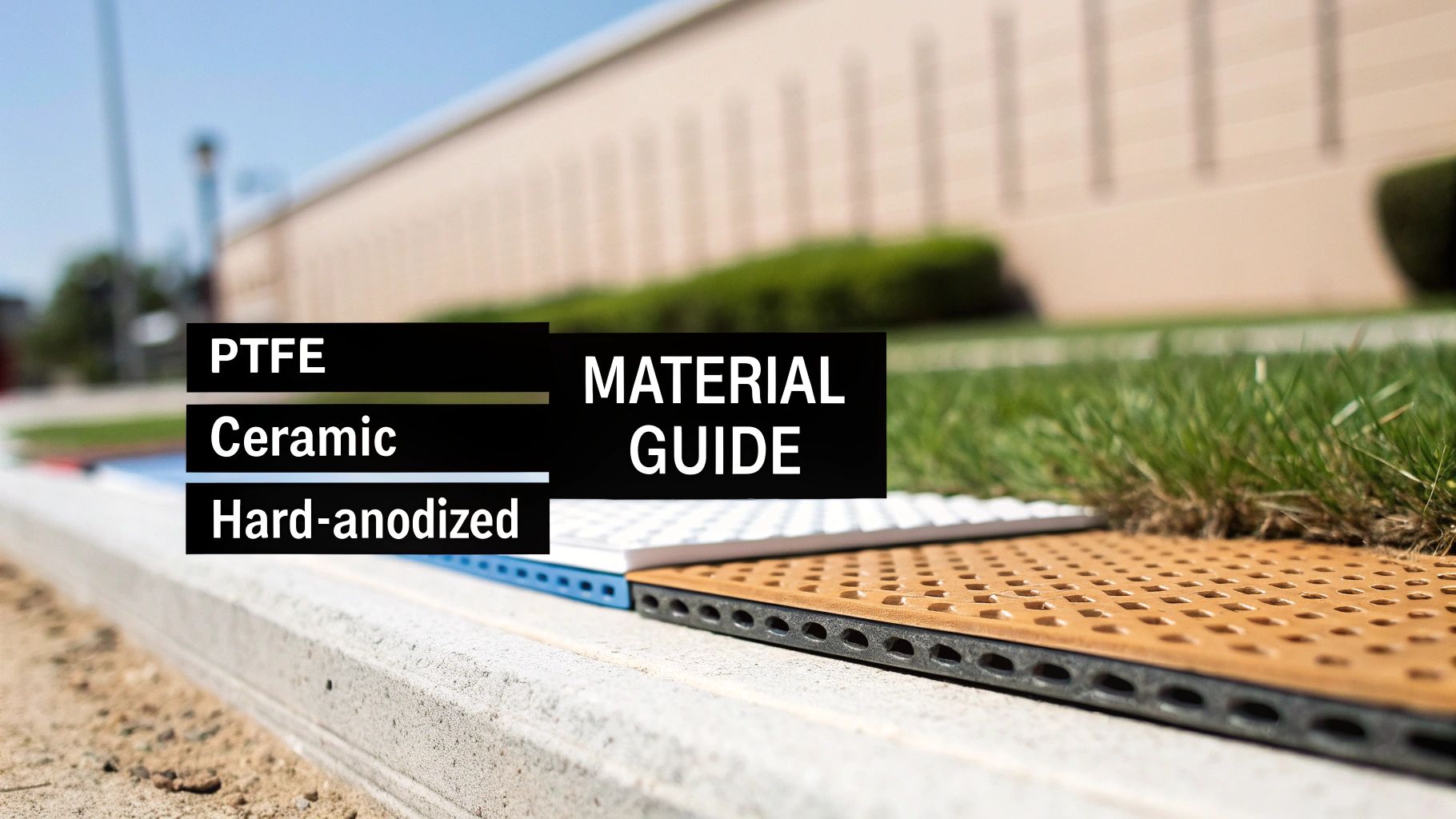
Before you can make sense of any best non stick cookware reviews, you have to know what you’re looking at. The real difference between a pan that becomes a kitchen workhorse and one that ends up in the bin comes down to the science behind its surface. This isn't just marketing fluff; the material dictates how your pan performs, how long it lasts, and even its safety.
Getting a handle on these materials helps you cut through the noise and choose a pan that actually fits how you cook. Whether you’re flipping delicate pancakes or searing a thick steak, the right surface is everything. Let's break down the three main players you'll find on the shelf.
The Original Slick Surface: PTFE Coatings
When most of us hear "non-stick," we immediately think of Polytetrafluoroethylene (PTFE), the compound that DuPont famously trademarked as Teflon. For decades, it was the undisputed champion of slippery surfaces, letting food glide right off with barely any oil. Its reputation, however, took a serious knock due to safety concerns over perfluorooctanoic acid (PFOA), a chemical once used in its manufacturing.
Fast forward to today, and you’ll see that virtually all modern PTFE pans are proudly labeled "PFOA-free," a massive improvement for kitchen safety. The old worry was that at very high temperatures—we're talking over 500°F (260°C)—the coating could start to break down and release fumes.
While today's PTFE is considered perfectly safe for normal home cooking, it has its own set of rules:
- Its Superpower: PTFE delivers an incredible food release. It's the go-to for anything delicate that can't risk sticking, like fish fillets, crepes, or scrambled eggs.
- The Heat Limit: Never, ever preheat an empty PTFE pan or crank it up for high-heat searing. Overheating will degrade the coating, ruining its non-stick magic and potentially posing risks.
- Handle with Care: The surface is relatively soft. Metal utensils are its mortal enemy, as scratches will cause the coating to break down much faster.
The Modern Challenger: Ceramic Coatings
Responding to the health concerns around traditional non-stick, ceramic non-stick coatings stormed onto the scene and have become a huge hit. It's a bit of a misnomer, though—this isn't the same ceramic as your dinner plates. It's a sand-derived silicone oil that’s sprayed onto the pan and cured with heat, creating a slick, glass-like finish. The best part? It's made completely without PTFE, PFOA, or any other per- and polyfluoroalkyl substances (PFAS).
This newer generation of cookware solves many of the old problems. The best ceramic pans are seriously impressive, holding their own against daily use with excellent durability and performance.
The biggest win for ceramic is its high heat tolerance. Many ceramic pans are oven-safe up to 550°F or more, letting you move from stovetop to oven without a second thought.
This ability to handle higher temperatures makes ceramic fantastic for getting a proper sear on meats and veggies. That perfect crust on a steak demands high heat, a task where a quality ceramic pan shines and a PTFE pan would be pushed past its limits. This versatility has made it a favorite among home cooks who like to do a little bit of everything.
The Foundation of a Great Pan: Hard-Anodized Aluminum
You'll often see the term hard-anodized aluminum, but it's important to know this isn't the non-stick coating itself. Instead, it describes the pan's core construction. It’s an electrochemical process that dramatically hardens aluminum, making it far more durable, scratch-resistant, and non-reactive than its standard counterpart.
Think of it as the pan's skeleton. This process creates a rock-solid base that won't warp under heat and, crucially, distributes heat beautifully and evenly across the entire cooking surface. Most top-tier non-stick pans, whether they have a ceramic or PTFE coating, are built on a hard-anodized aluminum body.
So, when you see a pan described this way, you know you're getting:
- Built to Last: The surface is harder than stainless steel, so it can take a beating without denting or scratching easily.
- No More Hot Spots: It heats up evenly, ensuring your food cooks uniformly instead of burning in one spot while staying raw in another.
- A Rock-Solid Base: This strong foundation is the perfect canvas for a high-performance non-stick layer, making the coating itself last longer and work better.
Here’s how we got our hands dirty to find the best non-stick pans out there.
Marketing claims and shiny brand names don't mean much when you're staring at a ruined omelet. We knew our recommendations had to be built on something real, which is why we developed a testing process that mirrors exactly what happens in a real home kitchen. We want to show you how we test so you can trust what we recommend.
We put every single pan through the wringer, focusing on four make-or-break performance areas. This gives us a complete picture of where a pan shines and where it falls short, ensuring a fair, head-to-head comparison every time.
Food Release Performance
This is the big one. Does "non-stick" actually mean non-stick? To find out, we use the classic oil-free egg test. We cook several eggs, one after another, in each pan over steady medium heat, watching to see if they slide out without any help.
Pans that let an egg glide right onto the plate with zero residue score top marks. It's a simple test that immediately exposes the quality of a non-stick coating. It’s no surprise that a recent 2025 survey found that 20% of buyers named cooking eggs as a primary reason for choosing non-stick. You can dig into more cookware performance data over at ConsumerReports.org.
Heat Distribution and Evenness
There's nothing more frustrating than a pan with hot spots that scorch one side of your food while leaving the other side pale and undercooked. To get past simple guesswork, we use a high-precision thermal imaging camera to see exactly how heat spreads across the cooking surface.
This tech gives us a visual map of the pan's performance, revealing any inconsistencies. A great pan shows a smooth, even color gradient from the center all the way to the edges, proving it can deliver consistent, controllable heat.
A pan with poor heat distribution is a recipe for frustration. It’s the reason your pancakes are blotchy or why your chicken gets a perfect sear on one side and looks sad on the other. Our thermal camera cuts through the nonsense.
Durability and Scratch Resistance
A good non-stick pan needs to be a workhorse. To simulate months and years of use, we perform a scratch resistance test. We go at the surface with common kitchen tools like nylon and wood spatulas. We even use metal ones (against the manufacturer’s advice, of course) to see how the pan handles an accidental scrape.
We also run abrasion tests to mimic the wear and tear from hundreds of cleanings. The pans that come out looking smooth and unbothered are the ones that earn our highest durability ratings.
Ergonomics and Handling
Finally, a pan just has to feel right. We assess the ergonomics and overall handling by focusing on the little things that make a big difference during daily cooking:
- Handle Comfort: Is the handle easy to grip, even with an oven mitt? And crucially, does it stay cool on the stovetop?
- Weight and Balance: Does the pan feel balanced and easy to lift, or is it clunky and front-heavy? A poorly balanced pan makes flipping veggies a real chore.
- Overall Design: We look at practical details like flared rims that allow for drip-free pouring and how securely the handle is attached to the pan’s body.
In-Depth Reviews of Top Non Stick Pans
Alright, now that we've covered the testing criteria, let's dive into the results. We put these pans through the wringer to see how they’d actually hold up in a real kitchen. We're breaking down who each one is best for, where it absolutely shines, and where you might find some trade-offs.
Our goal was to give you a straightforward, apples-to-apples comparison. This way, you can easily decide what’s right for you—whether that’s a super-durable pan for a busy family or one with precise heat control for your more ambitious recipes.
This little flowchart sums up our whole testing process. It hits the three big benchmarks every single pan had to pass.
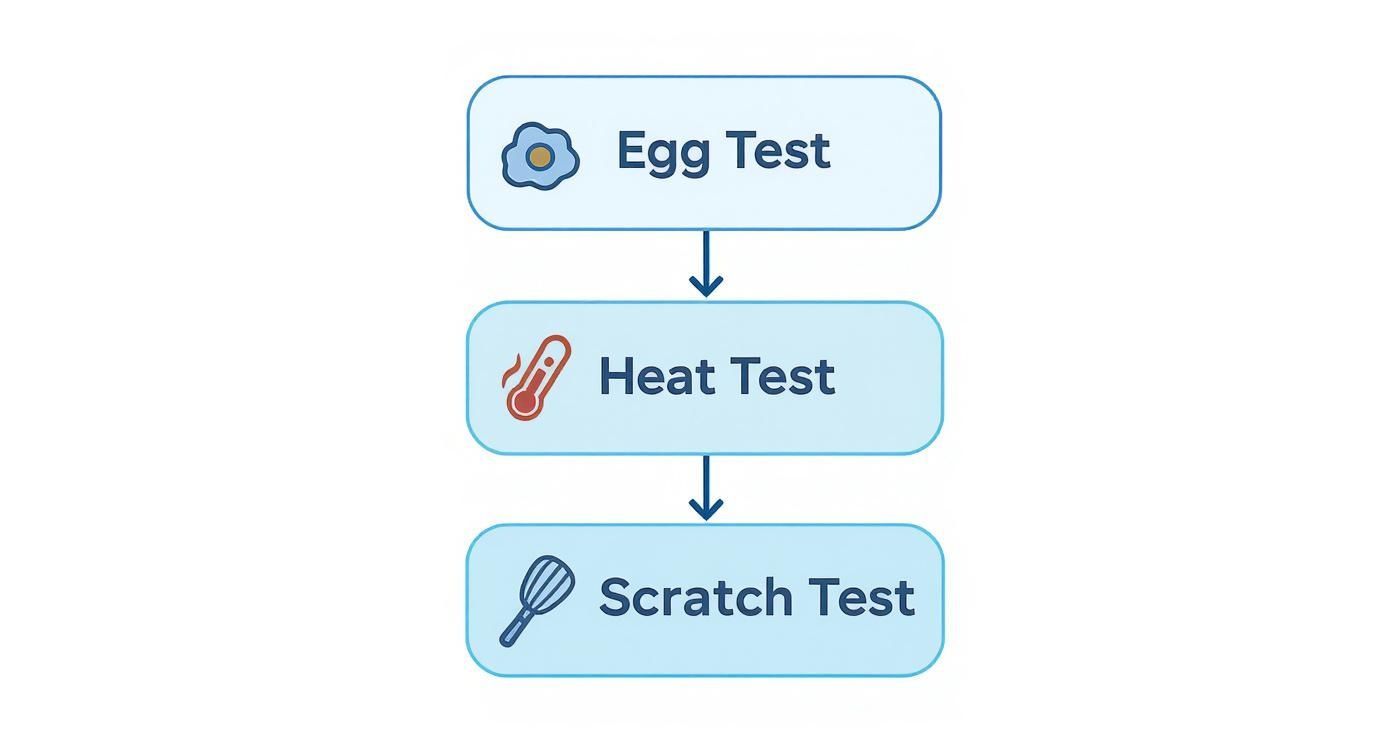
Ultimately, a pan’s true quality comes down to food release, heat distribution, and scratch resistance. Those are the pillars of a great non-stick experience, and they were the core of our evaluation.
Our Top Pick: Cool Brand Designs Deluxe Ceramic Set
The Cool Brand Designs deluxe ceramic set caught our attention right away, not just for its slick performance but for its smart, solid build. This isn't just another pretty set; it's a seriously well-made collection for the home cook who cares about safety and buying something that will last.
Its non-stick surface is a modern ceramic coating derived from sand, which means it’s completely free of PFAS, PFOA, and other sketchy chemicals. That's a huge plus, especially for health-conscious families who want that peace of mind.
But what really blew us away was the 9H anti-scratch coating. During our durability tests, it held up against nylon and wooden utensils way better than most competitors. This thing is clearly built to handle the chaos of daily cooking without breaking down.
That kind of toughness is a game-changer. So many non-stick pans start to fail as soon as they get a few micro-scratches, but this coating is in a different league. It's built for the long haul.
The kitchen performance was just as strong. In our oil-free egg test, the eggs slid right out, leaving almost nothing behind. Heat distribution was also fantastic, giving us perfectly even browning without any hot spots. To get a better look at the whole collection, you can check out the Cool Brand Designs deluxe 14-piece ceramic cookware set on their website.
- Who It's For: The serious home cook, health-conscious families, or anyone looking to upgrade their kitchen with a stylish, durable set. It also makes a fantastic wedding gift.
- Key Takeaway: With its top-tier scratch resistance and eco-friendly materials, this set is a smart investment for long-term performance and safety.
The Budget Champion: Carote 12-Piece Set
Let's be real—not everyone needs a premium cookware set. That’s where Carote comes in. It delivers surprisingly great performance at a price that’s almost impossible to beat, making it a perfect pick for first-time homeowners, college students, or anyone watching their wallet.
Right out of the box, the non-stick was incredible. It was honestly one of the best surfaces we tested for initial food release, handling everything from sticky cheese to delicate sausages with no sticking at all. Cleanup was a breeze.
But for that price, there are a couple of trade-offs. The handles, while comfy, started to show some scorching when we used them over a gas flame for a while. This didn't happen on our electric stove, but it's a potential durability issue for anyone with a gas range.
- Who It's For: Budget-conscious buyers, new homeowners, and anyone who values amazing non-stick performance right away more than long-term durability.
- Key Takeaway: An amazing value with fantastic non-stick capabilities, but just be careful with the handles if you're cooking on a high-heat gas stove.
The Aesthetic Choice: Caraway Cookware Set
Caraway has built its brand on stunningly beautiful cookware, and it's easy to see why. If your kitchen's style is as important as the meals you create, this set is a showstopper. It even comes with a brilliant magnetic storage system to keep your cabinets tidy.
The non-toxic ceramic coating performs well, especially in the pots we used for soups and sauces. They heat up evenly and are a genuine pleasure to use, with sleek stainless steel handles that feel great.
The one hang-up we had was with the frying pans. While they are non-stick, they seemed more sensitive to heat than other ceramic pans we tested. We also noticed the colorful exterior was prone to staining and burning, which can ruin that beautiful finish if you're not paying close attention.
- Who It's For: Design-focused home cooks who love an organized kitchen and are willing to treat their cookware with a little extra care.
- Key Takeaway: Absolutely gorgeous design and solid non-toxic performance, but the frying pans require careful heat management to keep them looking and working their best.
The Versatile Minimalist: Our Place Always Pan 2.0
The Always Pan pitches itself as the one pan to replace them all, and its versatility is definitely its biggest selling point. It comes with a nesting steamer basket and a built-in spatula rest, making it a killer solution for minimalist kitchens or anyone tight on storage space.
The non-stick surface, called Thermakind®, is impressively slick and has held up great over months of use. It handles delicate foods like a champ and cleans up in seconds. Plus, it’s made from 100% post-consumer recycled aluminum, which is a big win for sustainability.
There are a few design quirks, though. The square handle can feel a bit awkward, and the smaller helper handle gets dangerously hot. It’s also only oven-safe up to 430°F, which is a bit less than some of its competitors.
- Who It's For: Minimalists, small-space dwellers, and home cooks who want a multi-functional, eco-friendly pan.
- Key Takeaway: A super versatile and sustainable pan with a great non-stick surface, but the ergonomics and heat limits won't be for everyone.
Below is a quick-glance table to help you compare the key specs of each model we reviewed based on our hands-on testing.
Comparative Analysis of Top Non Stick Cookware
This table provides a feature-by-feature comparison of our reviewed cookware, with ratings based on our hands-on testing.
| Model | Coating Type | Durability Rating (1-5) | Heat Evenness (1-5) | Oven Safe Temp | Price Point |
|---|---|---|---|---|---|
| Cool Brand Designs Deluxe Set | Ceramic | 5 | 5 | 500°F | Premium |
| Carote 12-Piece Set | Granite PTFE | 3 | 4 | 350°F | Budget |
| Caraway Cookware Set | Ceramic | 4 | 4 | 550°F | High-End |
| Our Place Always Pan 2.0 | Ceramic | 4 | 4 | 430°F | Mid-Range |
This comparison should give you a clear, at-a-glance look at where each cookware set excels, helping you match the right features to your specific needs in the kitchen.
Taking Care of Your Non Stick Cookware
A great non stick pan is a true kitchen workhorse. To get the most out of your investment, a little know-how goes a long way. Following a few simple rules will keep that slick, food-release surface performing perfectly for years to come.
The good news? Proper care isn't complicated at all. It really just boils down to three things: heat, utensils, and how you clean up. Get these right, and you'll sidestep the common mistakes that send perfectly good pans into early retirement.
Mastering Temperature Control
One of the quickest ways to kill a non stick coating is to blast it with high heat. While many modern ceramic pans can handle an oven up to 550°F, the real damage happens on the stovetop. Preheating an empty pan on high is a classic mistake that can degrade the non stick surface in a hurry.
The golden rule for non stick is to cook low and slow. Always stick to low or medium heat, and get a little oil or butter in the pan before you turn on the burner. This creates a small protective barrier between your food and the pan’s surface.
This habit doesn't just save your pan's coating—it also helps your food cook more evenly. It's a win-win.
Choosing the Right Tools
The utensils you grab have a direct impact on your pan’s lifespan. Even though some of the tougher coatings out there can take an occasional knock, constantly using the wrong tools will create micro-scratches that eventually ruin the non stick magic.
To keep your cookware looking brand new, stick with these materials:
- Silicone: It's flexible, heat-resistant, and incredibly gentle on every type of non stick surface.
- Wood or Bamboo: These are classic choices for a reason—they're naturally soft and will never scratch your pans.
- Nylon: A solid, budget-friendly option that's safe for non stick, but just be careful not to leave it resting on a hot surface.
And whatever you do, never use metal utensils. Knives, forks, and metal spatulas are the number one cause of the scratches that lead to a failing coating.
Smart Cleaning and Storage Habits
Finally, how you clean and store your pans is just as critical. Even if a pan claims to be "dishwasher-safe," hand washing is always the better move. The intense heat and harsh detergents inside a dishwasher can slowly break down the non stick layer.
Instead, let your pan cool down completely after cooking. Then, just use a soft sponge and some mild dish soap. When it comes to storage, try to avoid stacking pans directly on top of one another. If you have to stack them, just place a soft dish towel, a paper towel, or a dedicated pan protector between each one to stop them from scratching.
Do you have a go-to trick for keeping your pans looking new? Share your best tips in the comments below or tag us on social media with your kitchen hacks! We’d love to see how you care for your favorite cookware and feature our favorites.
Your Top Questions About Non Stick Pans, Answered
Choosing the right cookware can feel like a big decision, and it’s natural to have a few questions. To give you total confidence in your choice, I’ve pulled together the most common queries we hear from home cooks. These are the critical details that often make the difference, answered based on our own hands-on testing and research.
We'll tackle everything from knowing when it's time to say goodbye to an old pan to getting the real story on coating safety. Think of this as the final piece of the puzzle, designed to clear up any lingering doubts before you invest in new non stick pans.
When Should I Replace My Non Stick Pan?
The most telling sign is simple: food starts to stick. That effortless, egg-sliding performance is the whole reason you bought the pan, and once that’s gone, it’s not doing its job anymore. This usually happens after the surface accumulates thousands of micro-scratches from regular use, even if you can't see them.
You’ll want to replace your pan immediately if you spot any deep gouges that expose the metal underneath or if the coating is visibly chipping or peeling. Cooking on a damaged surface is not only frustrating but can be a safety issue, especially with older-generation PTFE pans. As a general rule of thumb, expect a lifespan of one to five years, which really depends on the pan's quality and how you treat it.
Are Modern Non Stick Coatings Safe?
This is easily the biggest concern out there, and for good reason. The great news is that modern non stick cookware from any reputable brand is considered completely safe for everyday cooking at home. The main worry in the past revolved around a chemical called PFOA, which is no longer used in the manufacturing of PTFE coatings today.
These days, you're looking at two primary types of safe, non-toxic coatings:
- PTFE (PFOA-Free): This is the modern, safe version of what people think of as traditional non-stick. It’s perfectly fine as long as you avoid overheating it past 500°F (260°C).
- Ceramic: Made from a sand-derived coating, ceramic is naturally free from PTFE, PFOA, lead, and cadmium. It's become a go-to for health-conscious cooks.
PFOA-Free Versus PFAS-Free: What Is the Difference?
This is where a lot of the marketing jargon gets confusing, so let’s break it down. Think of PFAS (per- and polyfluoroalkyl substances) as a huge family of thousands of different man-made chemicals. PFOA is just one specific member of that massive family.
So, when a pan is labeled "PFOA-free," it means it doesn't have that one specific, well-known chemical. But when a pan is labeled "PFAS-free," it means it was made without any of the chemicals from that entire group. True ceramic cookware is always PFAS-free.
For anyone wanting the highest level of assurance, the "PFAS-free" label is the most complete guarantee you can look for.
Can I Use Metal Utensils on My Pans?
The short answer here is almost always a hard no. I know some high-end pans claim their coatings are "metal-utensil-safe," but it's a risky habit that will dramatically shorten the lifespan of any non stick surface. Metal spatulas, forks, and whisks are just too abrasive and will inevitably create tiny scratches.
Over time, these micro-scratches build up and completely ruin the pan’s ability to release food. If you want to protect your investment, always stick with silicone, wood, or nylon utensils. This one small change in habit is probably the single most effective thing you can do to make your cookware last.
Why Is My New Pan Already Sticking?
If a brand-new pan is giving you trouble, the culprit is almost always heat or cleaning. The number one mistake people make is using too much heat. Non stick pans are designed for low-to-medium temperatures, and cranking the flame too high can scorch food onto the surface, creating a sticky residue.
Another common issue is an invisible buildup of oil. Cooking sprays and certain oils can polymerize over time, forming a thin, sticky film that soap and water won't easily remove. The best practice? Always preheat your pan gently on low with a little bit of butter or oil, and clean it thoroughly (but gently!) after it has cooled down completely. The market is always improving, with double-layer coatings expected to see an 18.5% growth rate between 2025-2032 by offering a better balance of price and durability. You can discover more insights about non-stick coating innovations at Data Bridge Market Research.
Ready to upgrade your kitchen with a cookware set that is safe, durable, and beautiful? Explore the full collection from Cool Brand Designs and find the perfect match for your cooking style. Visit https://www.coolbranddesigns.com to shop now and follow us on social media for daily cooking inspiration and exclusive deals


