Forget the expensive gadgets for a moment. Your first, and arguably best, line of defense against car theft doesn't cost a dime. It’s all about building smart, consistent habits. The goal is to get inside a thief’s head, understand what they're looking for, and make sure your car is the opposite of an easy target. Follow us for more tips and share this guide to help keep our communities safe!
Build Your First Line of Defense with Smart Habits
Before you even think about alarms or steering wheel locks, the most powerful tool you have is simple awareness. Most car thefts are crimes of opportunity. A thief is scanning the street for the path of least resistance—the quickest, quietest, and most rewarding target they can find. Your job is to make your car look like too much trouble.
This is more than just remembering to lock your doors. It's about developing a proactive mindset every single time you park your car. Take two seconds and look at it from an outsider's perspective. Are you accidentally rolling out the welcome mat for someone with bad intentions? That tiny bit of caution can save you from a world of headaches, insurance calls, and financial loss.
The Psychology of an Opportunistic Thief
To stop a thief, you need to know what they want. It’s usually pretty simple:
- A quick grab. They want to be in and out with minimal noise or attention drawn to them.
- A visible prize. A laptop bag on the passenger seat, a smartphone in the center console, or a wallet tucked in the door pocket is an open invitation.
- An easy entry. An unlocked door is the jackpot. A car that looks old or easy to break into is a close second.
- A low-risk setting. Dark, isolated streets or massive, crowded parking lots where they can easily blend in are prime hunting grounds.
When you actively work against these four things, your car becomes instantly less appealing. A clean car with nothing inside, parked right under a streetlight, is a far less tempting target than the one with a backpack visible, sitting in a dark corner of the lot. For more quick security tips like these, follow us on our social channels!
Common Habits That Invite Theft
It’s easy to get complacent, especially when you’re in a hurry or in a neighborhood you know well. But those little lapses in judgment are exactly what thieves are waiting for.
Think about the classic "puffer" car scenario on a freezing morning. You run out, start the engine to warm it up, and pop back inside for just a minute. To a thief, that's a gift-wrapped car—unlocked, running, and ready to be driven away in under ten seconds. Another classic mistake is hiding a spare key somewhere on the vehicle. Thieves know all the usual spots: under the bumper, inside the gas cap, or in one of those little magnetic boxes. They'll check.
"The single most effective anti-theft device is a cautious owner. Technology can be bypassed, but good habits create a constant state of deterrence that makes your vehicle a less profitable and riskier target."
The statistics on car theft might surprise you. Even with all the modern security tech, a motor vehicle is still stolen approximately every 37 seconds in the United States. Groups like the National Insurance Crime Bureau (NICB) are on the front lines, tracking these trends to help law enforcement and the public stay ahead.
The NICB's website is packed with resources and data, making it clear that a team effort between police, insurance companies, and vehicle owners is the only way to drive down theft rates. Even with a significant 17% drop in thefts in a recent year, the sheer number of stolen vehicles shows why we can't let our guard down. You can dig into the specifics in the NICB's annual reports or see a quick rundown of the latest numbers. Learn more about recent car theft statistics.
Install Physical Barriers That Stop Thieves Cold
Good habits are your first line of defense, but sometimes you need to make a bigger statement. Physical barriers are that statement. They’re the loud, in-your-face obstacles that tell a thief, "This isn't the car you're looking for." Visit our website to see a curated collection of effective deterrents.
Think about it from their perspective. A thief scoping out a parking lot wants the easiest, quietest target. When they peer through your window and see a bright yellow steering wheel lock or a heavy-duty clamp on the brake pedal, their entire calculation changes. Stealing your car just went from a 30-second job to a noisy, tool-intensive project. Most will just move on.
It’s all about layering your security. The infographic below sums up the foundational habits that these physical devices build upon.
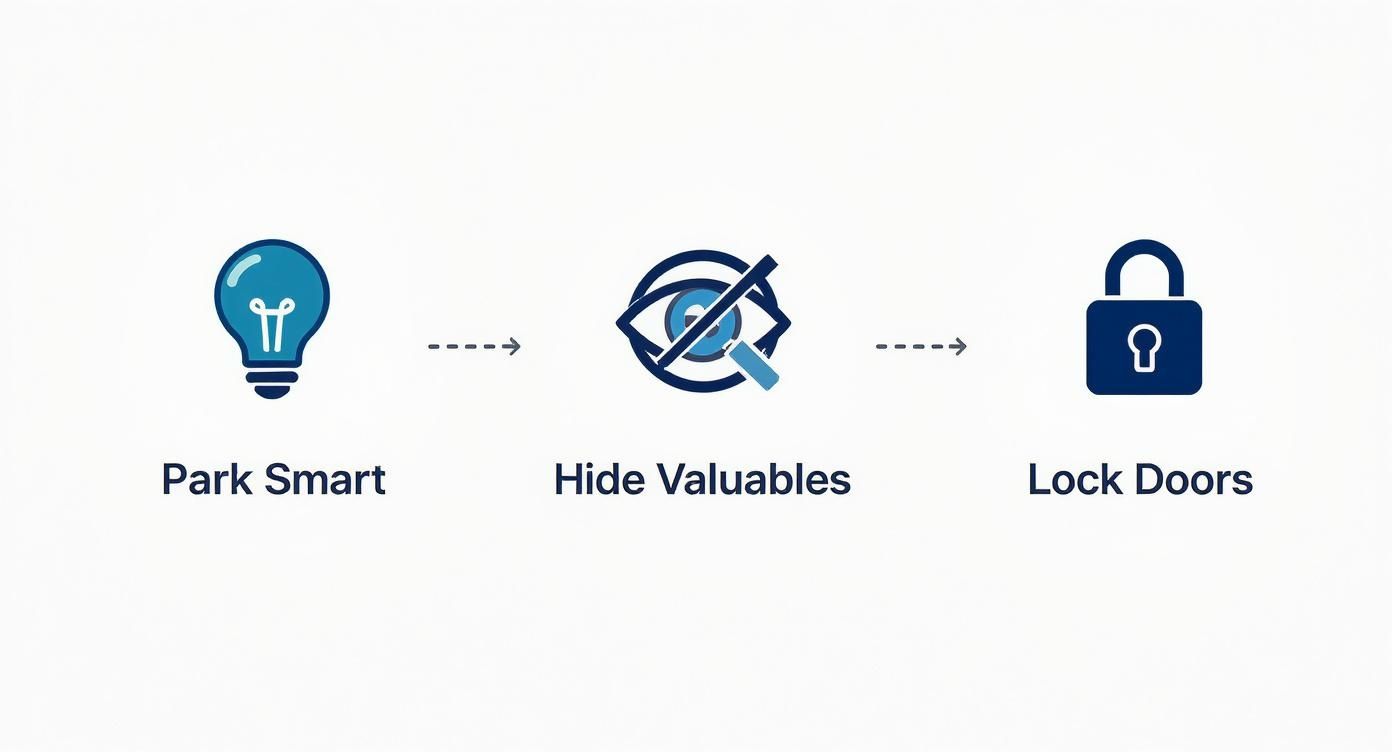
As you can see, simple actions—where you park, what you leave inside, and always locking up—are the bedrock of any solid anti-theft strategy. Don't forget to share this infographic on social media to help your friends and family stay safe!
Old-School Tools That Still Work Wonders
In a world of keyless entry and digital hacks, it’s easy to overlook the classics. But their simplicity is exactly what makes them so effective. They’re brutally physical and can't be bypassed with a laptop.
- Steering Wheel Locks: This is the most iconic physical deterrent for a reason. A quality lock like "The Club" makes the steering wheel impossible to turn, rendering the car useless. It’s cheap, simple, and a fantastic visual warning.
- Brake or Clutch Pedal Locks: A bit less common, but incredibly effective. These devices lock your brake or clutch pedal in place. If a thief can't press the brake, they're not going anywhere safely or quietly.
- Tire Clamps (Boots): If you need maximum security for a vehicle in long-term storage or a high-value car, the boot is the final word. It physically prevents the wheel from rotating, stopping a thief dead in their tracks.
These devices are the perfect counter to the opportunistic thief who is banking on a quick, silent job. They might have the tech to deal with an alarm, but they probably aren't carrying a hacksaw.
To help you decide which physical deterrent is right for you, here's a quick comparison of the most common options.
Physical Anti-Theft Device Comparison
| Device Type | Primary Function | Best For Deterring | Average Cost |
|---|---|---|---|
| Steering Wheel Lock | Immobilizes the steering wheel | Opportunistic thieves, joyriders | $25 - $100 |
| Brake/Clutch Pedal Lock | Prevents pedal depression | Determined thieves, prevents driving | $40 - $120 |
| Tire Clamp (Boot) | Prevents wheel rotation | Long-term storage, high-value cars | $50 - $250 |
| OBD Port Lock | Blocks access to the diagnostic port | High-tech thieves, key cloning | $30 - $80 |
Ultimately, the best choice depends on your specific vehicle, where you park, and the level of risk you're trying to mitigate. Check out our product guides at Cool Brand Designs for more in-depth reviews.
Protecting Against Modern Digital Theft
Cars are basically computers on wheels now, and thieves have updated their toolkits accordingly. They can clone your key fob signal or, more commonly, hack directly into your car's brain through its diagnostic port. This is where a new generation of physical barriers comes in.
An OBD (On-Board Diagnostics) port protector is a must-have for any modern vehicle. This small metal lock covers your car's OBD-II port, the very same one your mechanic uses. Thieves plug into this port to reprogram a blank key and drive away in seconds.
By physically blocking the OBD port, you shut down their number one high-tech attack route. It's a simple, affordable fix that neutralizes a huge vulnerability.
This is no longer a niche threat; it's how professional crews operate today. For a deeper dive, check out our guide on OBD2 port hacking prevention to see just how these security locks work. It's a one-time install that provides constant protection.
Another fantastic, low-tech defense against professional thieves is VIN etching. This involves permanently etching your car's Vehicle Identification Number onto every piece of glass—the windshield, windows, and mirrors. While it won't stop someone from driving the car away, it absolutely tanks its value on the black market.
Why? The most profitable theft operations are "chop shops" that dismantle cars for parts. A car with an etched VIN means they have to replace every single expensive piece of glass before selling the parts. That extra cost and hassle often makes your car not worth the trouble. It’s a subtle but brilliant way to make your car a bad investment for criminals.
Fight Back With Smart Tech
While a big, chunky steering wheel lock sends a clear visual message, modern tech gives you a smarter, more active way to protect your car. The latest anti-theft gear does more than just make a racket; it can ping your phone instantly, kill the engine, and even help the police track your vehicle down if the worst happens. This is where you outsmart the thieves.
It's easy to get lost in all the options, from simple alarms to fancy tracking systems with monthly fees. The trick is figuring out what each tool does and how it fits into your overall security plan, letting you build a digital fortress around your ride. Check out our blog at Cool Brand Designs for the latest reviews on cutting-edge security tech.
Alarms and Immobilizers: The Unseen Guardians
Just about every car made in the last 20 years has a factory-installed engine immobilizer. It’s a tiny transponder chip in your key that has a digital handshake with your car's brain, the engine control unit (ECU). If the ECU doesn't get the right signal from your key, the engine won't start. Period. It's the original, and still effective, anti-hot-wiring tech.
Car alarms have gotten a lot smarter, too. Instead of just blasting a siren that everyone ignores, good aftermarket systems can buzz your smartphone the second something's wrong. These sensors are on the lookout for:
- Impact or shock: You'll know if someone bumps your car or smashes a window.
- Tilt or motion: Get an alert if your car is being towed or jacked up for its wheels.
- Voltage drop: Senses a door opening or tampering with the battery.
Getting that instant notification means you can react immediately—peek outside, call security, or dial 911. It turns a passive noisemaker into an active security monitor that’s always on watch.
GPS vs. Radio Frequency Trackers: Know The Difference
Okay, so a thief got past your locks and alarm and is driving away. A hidden tracking system is your absolute best chance of ever seeing your car again. Think of it as your secret weapon, silently reporting its location. But not all trackers work the same way.
-
GPS (Global Positioning System) Trackers: These are what most people think of. They use satellites to pinpoint your car's location on a map, which you can usually see on a phone app. GPS is super accurate in the open, but the signal can get blocked if the car is hidden in an underground parking garage or a metal shipping container.
-
RF (Radio Frequency) Trackers: These trackers emit a silent radio signal. They aren't for real-time mapping like GPS, but their signal is much tougher to block. Police can use a special directional finder to trace the signal, even if your car is tucked away deep inside a building where GPS can't reach.
The best systems actually use both. They rely on GPS for general tracking but have an RF beacon that can be activated to help police zero in for the recovery. This dual-tech approach dramatically boosts the odds of getting your car back in one piece.
Deciding between them comes down to things like subscription costs, how often you need to charge the device, and whether you want to self-monitor or use a service that works directly with law enforcement. For a deeper dive into specific products, our guide on car theft prevention devices breaks down the top tech available.
Know If Your Car Is a High-Risk Target
Not all cars are created equal, especially in the eyes of a thief. While any vehicle can be a target, criminals definitely play favorites. Figuring out if your car is on their "most wanted" list is the first step toward building a smart defense.
This isn't about making you paranoid; it’s about making you prepared. If you drive a high-risk vehicle, you just need to be more diligent and layer your security more thoughtfully than someone whose car flies under the radar. Knowledge is power, and in this case, it’s the power to make your car a much harder target.
Why Certain Cars Get Stolen So Often
Theft is rarely random. It's a business, and thieves target specific vehicles for a few key reasons—all driven by pure economics and logistics. What's easy to take, and what's profitable to sell?
Here's what usually motivates them:
- Known Security Flaws: Sometimes, a manufacturer messes up, and a specific model has a well-known vulnerability that thieves learn to exploit. We all saw this with the infamous social media trend that taught thieves how to start certain Kia and Hyundai models with just a USB cable.
- High Demand for Parts: Popular, high-volume cars are gold mines for chop shops. A thief can dismantle a common sedan or truck and sell its parts—from airbags and catalytic converters to doors and engine components—for far more than the value of the whole car.
- Ease of Resale: High-end luxury cars or powerful trucks are often stolen "to order." They get shipped overseas or resold with forged documents because there’s a ready black market for them.
Recognizing which of these risk factors applies to your car helps you choose the right preventative measures.
The Most Targeted Makes and Models
Data consistently shows that a handful of vehicles get hit disproportionately year after year. The Hyundai Elantra and Hyundai Sonata have recently topped the list of most stolen vehicles. Other frequent targets include the Chevrolet Silverado 1500, the Honda Accord, and the Kia Optima, which highlights their specific vulnerabilities and the high demand for their parts.
You can discover more insights about the most stolen vehicles to see if your car is on the list. But it's not just sedans. Full-size pickup trucks like the Chevrolet Silverado and Ford F-Series are perennial favorites for thieves due to their high value, both whole and stripped for parts. Their sheer popularity on the road also makes them easy to blend in with once stolen.
Owning a popular vehicle doesn't mean it will be stolen; it means you're playing defense on a different level. Thieves already know the playbook for your car, so you need a better one.
Here’s a quick look at some of the most targeted vehicles and the most effective ways to protect them.
Top 5 Most Stolen Vehicles and Recommended Protections
| Vehicle Model | Key Vulnerability | Recommended Prevention Strategy |
|---|---|---|
| Hyundai Elantra/Sonata | Lack of engine immobilizer in pre-2022 models. | Get the free dealership software update. Use a highly visible steering wheel lock like The Club. |
| Kia Optima/Forte/Soul | Same immobilizer vulnerability as Hyundai models. | Prioritize the dealership software update. Add an aftermarket alarm or kill switch for another layer. |
| Chevrolet Silverado 1500 | High value for resale and parts; vulnerable to relay attacks. | Use a Faraday pouch for key fobs. Install an OBD-II port lock and a catalytic converter shield. |
| Ford F-Series Pickup | High demand for parts and ease of blending in. | Get VIN etching on all windows. A high-quality GPS tracker is a smart investment for recovery. |
| Honda Accord/Civic | Extremely high demand for parts on the black market. | Use a steering wheel lock or brake lock. Etch the VIN on parts and consider a catalytic converter shield. |
Understanding these vulnerabilities allows you to apply targeted security measures that directly counter the methods thieves are most likely to use on your specific vehicle.
Tailored Advice for High-Risk Vehicle Owners
If your car is on that list, it's time to get serious. You need to create obstacles that directly counter your vehicle’s specific weaknesses.
For Kia and Hyundai Owners (Pre-Immobilizer Models)
Your car's main weakness is the lack of a factory engine immobilizer. This is ground zero for your security efforts.
- Essential Fix: Get the free software update from your dealership. This is your first and most important step. No excuses.
- Physical Deterrent: Use a highly visible steering wheel lock. This visually signals that the easy exploit won't work here, hopefully convincing a thief to move on.
- Tech Solution: Consider an aftermarket alarm or kill switch to add another electronic barrier that thieves won't be expecting.
For Popular Truck and Sedan Owners (Silverado, Accord, Camry)
Here, the risk comes from the sky-high demand for your vehicle's parts. Your goal is to make your car a terrible candidate for a chop shop.
- VIN Etching: Have your Vehicle Identification Number (VIN) etched onto the windows and major parts. This makes your components less attractive to chop shops because they're harder to sell.
- Catalytic Converter Shield: These are prime targets, easy to steal in minutes. Installing a protective shield makes a quick snatch-and-grab much more difficult and noisy.
- GPS Tracker: Since your vehicle is a valuable asset, a tracker is a smart investment. It won't stop the theft, but it massively increases the odds of a rapid recovery.
What to Do If Your Car Is Stolen: Your Action Plan
Even with every precaution, the unthinkable can happen. That gut-wrenching, sinking feeling when you walk up to an empty parking space where your car should be is something no one wants to experience. But in that moment, panic is your enemy. Having a clear plan is the key to maximizing your chances of a quick recovery.
This isn't about prevention—it's about what to do after the fact. The first 24 hours after a car is stolen are absolutely crucial. Acting fast and methodically can make all the difference between getting your vehicle back and it disappearing for good.
Your Immediate First Steps
The second you confirm your car is gone—and not just towed—the clock starts ticking. Don't waste a moment.
Your first move? Call the police. Dial your local police department's non-emergency number unless you witnessed the theft in progress (in that case, call 911). Be ready to give them a clear, concise report.
You'll need to provide a file cabinet's worth of information, and having it ready is a game-changer. This includes:
- Your car's make, model, year, and color.
- The license plate number.
- The Vehicle Identification Number (VIN). This is the single most important detail.
- Any unique features, like a bumper sticker, a noticeable dent, or an aftermarket part.
This is exactly why a little prep goes a long way. Keep a photo of these details on your phone or in a cloud account. Having your VIN and plate number handy allows law enforcement to get your car into the national stolen vehicle database almost instantly.
Notify All Necessary Parties
Once you’ve filed the police report, your job isn't done. The next round of calls is just as important for protecting yourself financially and legally.
Your very next call should be to your insurance company. The agent will open a claim and walk you through their process. They'll need the police report number, so be sure you get it from the officer. Reporting the theft quickly helps protect you from liability if the thief gets into an accident.
After that, if your car has a GPS or radio frequency tracker, contact the service provider immediately. Give them the police report number and authorize them to start tracking. Many of these services coordinate directly with law enforcement, feeding them the real-time location data needed to recover your vehicle.
A clear-headed action plan can turn a moment of chaos into a structured recovery effort. The faster you act and the more information you provide, the better your odds of seeing your car again.
Prepare for the Worst-Case Scenario
While everyone hopes for a swift recovery, you should also be ready for a longer process. Keep a digital file with photos of your car from all angles, along with copies of your title and registration. This will be invaluable for both the police investigation and your insurance claim.
If the theft was caught on camera, that footage is a massive asset. This is where modern tech can really help. A device like the 1440p HD 360 Dual Camera Full HD Night Vision Car Dash Camera could provide law enforcement with a clear image of the thief or vital details about how the theft occurred.
Finally, you might need to report the theft to your state's Department of Motor Vehicles (DMV). Some states require this to ensure you aren't held liable for any tickets or tolls the thief racks up. Check your local DMV's website for their specific rules on stolen vehicles. By following these steps, you build a solid response that covers all your bases during an incredibly stressful time.
Answering Your Top Car Security Questions
Even after setting up a solid security system, you probably still have a few questions rolling around in your head. Getting the finer details right can help you sidestep common myths and give you real confidence that your car is as safe as it can be.
Let's dive into some of the most frequent questions we get from fellow car owners. My goal here is to give you straight, no-nonsense answers that build on the strategies we've already covered. If you have more questions, drop them in the comments or on our social media!
Will Anti-Theft Devices Actually Lower My Car Insurance?
Yes, they often will—and sometimes by a surprising amount. Insurance companies love to see proactive owners because every car that doesn't get stolen saves them from a massive claim. It's a win-win.
But here's the catch: not all security gadgets are created equal in their eyes.
Insurers give the best discounts for passive anti-theft devices. These are the ones that arm automatically when you lock up, like factory alarms, engine immobilizers, and good tracking systems. The "active" devices, like a steering wheel lock you have to put on yourself every time, might get you a smaller discount, if any. The only way to know for sure is to call your insurance agent and ask them directly what devices they'll reward you for.
Are Keyless Entry Cars Just Easier To Steal?
They can be, but only if you miss one ridiculously simple trick. The biggest weakness with keyless entry is a high-tech heist called a relay attack. Thieves use a special gadget to pick up the signal from your key fob—even if it's sitting on your kitchen counter—and "relay" it to their partner standing by your car. This fools your vehicle into thinking the key is right there, and poof, they're in.
The fix for this is almost laughably easy and cheap. Just toss your key fob into a signal-blocking Faraday pouch or even a simple metal tin. It completely shuts down the attack. It’s a tiny habit that neutralizes a huge threat.
On top of that, many newer fobs now come with built-in motion sensors. If the key doesn't move for a few minutes, it goes into a "sleep mode," which also stops relay attacks cold. Check your car's manual to see if you have this feature.
Is A GPS Tracker Really Worth It For An Older Car?
Without a doubt. A GPS tracker is a fantastic investment for pretty much any vehicle, no matter how old it is or what it's worth on paper. In fact, thieves often go after older cars because they don't have the fancy built-in security of new models, and their parts are always in demand.
Think about it beyond the car's sticker price. Imagine the headache, the cost of finding a replacement, and losing whatever personal stuff you had inside. For a small upfront cost, a GPS tracker gives you invaluable peace of mind and dramatically boosts the odds of getting your car back fast. It's a smart move for protecting your property.
At Cool Brand Designs, we know that having the right gear makes all the difference. From our heavy-duty OBD port locks to other must-have automotive tools, we're here to help you build a defense that thieves can't beat. Take a look at our handpicked collection of security solutions and take the next step in protecting what's yours. Visit us at https://www.coolbranddesigns.com to find the perfect gear for your car. Follow us on social media for the latest deals and security updates
Article created using Outrank


