The best home workout gear isn't about having the most expensive or complicated stuff—it's about finding what works for you. It’s the equipment that lines up perfectly with your fitness goals, your living space, and your budget.
For a killer start, all you really need is a solid combination of resistance bands, a high-quality yoga mat, and a set of adjustable dumbbells. This simple trio is your foundation, letting you tackle strength, cardio, and mobility without needing a whole separate room.
Your Perfect Home Gym Starts Here
Jumping into home fitness is exciting, but let’s be real: the sheer amount of equipment out there can make your head spin. This guide is here to cut through that noise and be your personal roadmap. Instead of just throwing a list of products at you, we’re going to help you build a setup that actually fits your life.
Forget the idea that you need a garage packed with bulky machines to see real results. The secret is making smart, strategic choices. We'll walk through the main categories—cardio, strength, and mobility—and show you how to pick pieces that give you the biggest bang for your buck.
What to Expect from This Guide
Think of this as more than just a shopping list; it’s a blueprint for creating a fitness routine you’ll actually want to stick with.
Here’s what we’ll cover:
- Goal-Oriented Advice: Figure out which tools are best for building muscle, boosting your endurance, or finally touching your toes.
- Space-Saving Solutions: We've got you covered with gear that’s perfect for small apartments and multi-purpose rooms.
- Budget-Friendly Options: Find our top picks for every price point, from awesome affordable basics to high-tech smart equipment.
More people than ever are building their fitness routines at home, and for good reason. The U.S. home fitness equipment market is expected to hit a massive USD 4.07 billion in 2025. If you're curious, you can learn more about these home fitness market trends and see the full analysis.
To give you a quick head start, we put together a simple table below. It matches common fitness goals with the ideal starter gear, so you can get actionable advice right from the get-go.
Quick Guide to Home Workout Gear by Fitness Goal
This table gives you an at-a-glance look at the best starter gear for common fitness objectives, helping you quickly find what you need.
| Fitness Goal | Essential Gear | Good to Have |
|---|---|---|
| Build Muscle/Strength | Adjustable Dumbbells, Resistance Bands | Pull-Up Bar, Weight Bench |
| Improve Endurance/Cardio | Jump Rope, Kettlebell | Foldable Treadmill, Stationary Bike |
| Increase Flexibility/Mobility | Yoga Mat, Foam Roller | Stretching Strap, Pilates Ball |
Think of this as your cheat sheet. It’s a straightforward way to see what basics will get you moving toward your goal and what you might want to add later as you progress. For daily tips and gear highlights, be sure to follow us on social media!
How to Choose Your Home Workout Gear
Alright, let's build your home gym shopping list. It doesn't have to be complicated. The whole process boils down to answering just three key questions: What are my goals? What's my space situation? And what's my budget? If you're honest with yourself on these three points, you'll end up with gear you actually use, not just stuff that collects dust.
Think of it like you're planning a road trip. You wouldn't just hop in the car and start driving. You need a destination (your goals), a car that gets you there (your space), and money for gas (your budget). Your fitness journey is no different. A little planning upfront saves you from wasting time and money on equipment that's a poor fit.
Align Your Gear with Your Fitness Goals
First things first: match your equipment to your ambitions. What are you trying to accomplish? Are you looking to build serious muscle, boost your cardio endurance, or just move your body more and feel better? Different goals demand different tools.
It’s pretty intuitive—if you’re focused on getting stronger, you’re naturally going to look at weights. If you're training for a 5K, cardio machines will be on your radar.
This decision tree gives you a visual for how your primary goal—whether it's muscle gain or better endurance—points you directly to the right category of equipment.
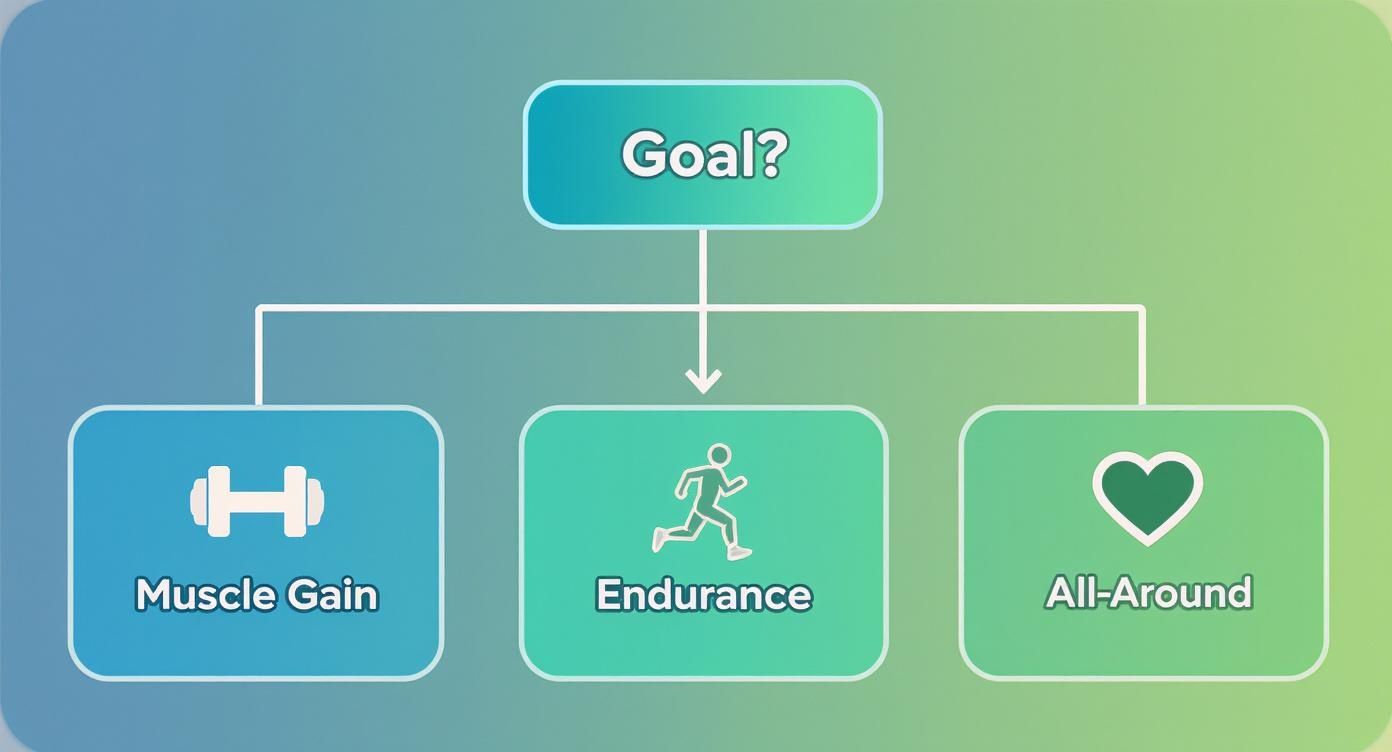
As you can see, figuring out your "why" is the most critical filter. It immediately cuts through the noise and narrows down the massive world of fitness gear to only what's truly relevant to you.
Make the Most of Your Available Space
Now, let's get real about real estate. You absolutely do not need a dedicated home gym to get an incredible workout. The trick is to buy gear that fits the space you actually have, not the one you wish you had.
- For Small Corners: If you're working with a little nook in your living room or bedroom, portability is your best friend. Think resistance bands, a yoga mat, a jump rope, and a set of adjustable dumbbells. Those dumbbells are a game-changer, giving you the versatility of a full weight rack in the space of just one pair.
- For Larger Areas: Got a spare room or some garage space? Now you can think bigger. This is where you can bring in things like a foldable weight bench, a stationary bike, or even a compact treadmill to round out your setup.
The best equipment isn’t just effective; it’s accessible. If setting up and breaking down your gear is a huge pain, you're just not going to use it. Always prioritize convenience to build a habit that sticks.
Invest Wisely at Any Budget
Finally, let's talk money. Your budget will obviously guide your final choices, but the great news is that you can build a powerful home workout setup at any price point. Seriously.
- Budget-Friendly (Under $100): You can build a fantastic, do-it-all kit with just the essentials. A set of loop resistance bands ($20-$40), a quality yoga mat ($25-$50), and a speed jump rope ($10-$20) give you endless options for strength, cardio, and mobility workouts.
- Mid-Range ($100-$500): In this bracket, you can level up with a few key pieces. This is where you can grab those adjustable dumbbells or a solid kettlebell. You could also find a quality suspension trainer or a foldable weight bench, which dramatically expands what you can do for strength training.
- Premium Investment ($500+): With a bigger budget, the door opens to larger cardio machines or smart fitness equipment. A high-quality rowing machine or a smart bike can easily become the centerpiece of your home gym, offering guided workouts and detailed performance tracking to keep you motivated.
Finding the Right Cardio Equipment
Cardio is the engine of any great fitness plan, but picking the right machine can feel a bit like choosing a new car. You’ve got the heavy hitters—treadmills, ellipticals, bikes, and rowers—and each one offers a totally different experience. The real key is to find something that feels less like a chore and more like a true partner in your fitness journey.
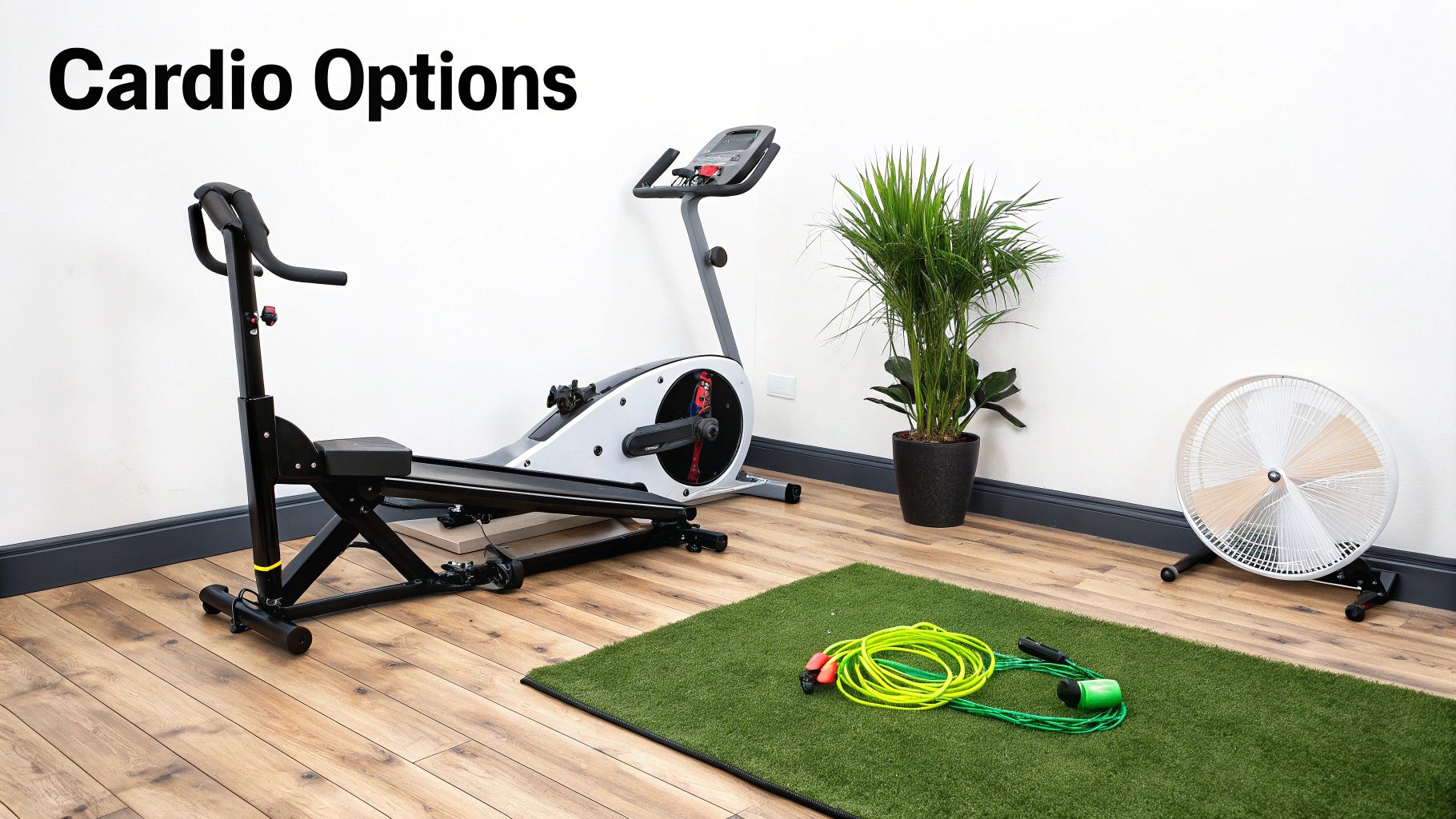
This decision is about way more than just burning calories; it’s about finding a rhythm that works for your body and your home. For example, ellipticals are fantastic for a smooth, low-impact glide that’s incredibly easy on your joints. On the other hand, a rowing machine is like the conductor of a full-body orchestra, engaging over 85% of your muscles in a single, powerful stroke.
The demand for solid at-home cardio options is massive. In fact, cardiovascular training equipment completely dominates the market and is projected to account for a whopping 63% of revenue in 2025. This boom is fueled by the universal goals we all share: improving heart health, managing weight, and boosting endurance. You can discover more insights about the home gym equipment market to get the full picture of why these machines are flying off the shelves.
Comparing the Cardio Champions
Each machine really has its own personality. A treadmill offers the most straightforward way to run or walk indoors, but it can be noisy and tough on the knees over time. If you're tight on space, an under-desk treadmill like this Walking Pad 2-in-1 Under Desk Treadmill can be a great alternative, letting you get your steps in while you work.
Stationary bikes provide an excellent lower-body workout and are often quieter and more compact than treadmills. Then you have rowers, which deliver an intense, full-body challenge that builds both strength and stamina simultaneously.
Let's break down the key factors to think about:
- Impact Level: Ellipticals and bikes are low-impact, making them ideal if you have sensitive joints. Treadmills are high-impact, while rowers sit comfortably right in the middle.
- Noise and Footprint: Be honest about your living situation. A rower or treadmill can create significant noise and take up a lot of floor space, whereas a stationary bike or a foldable elliptical is often much more apartment-friendly.
- Muscle Engagement: A rower is the undisputed champion here for full-body engagement. Bikes primarily target your legs, while ellipticals bring some upper-body movement into the mix.
Don't Overlook the Budget-Friendly Options
You absolutely do not need a large, expensive machine to get your heart pumping. Some of the best home workout gear is surprisingly simple and affordable.
A simple jump rope can provide a high-intensity workout that torches calories, improves coordination, and strengthens your entire lower body. It’s portable, costs next to nothing, and can be used almost anywhere.
Kettlebells are another fantastic choice. They are perfect for high-intensity interval training (HIIT) circuits that build explosive power and cardiovascular endurance at the same time. These simple tools are proof that a powerful cardio workout is accessible at any budget.
Building Strength with the Right Gear
If you want to build real muscle and power at home, free weights are still king. There's just no substitute. They make your body work harder to stabilize itself, which fires up more muscles and builds the kind of functional strength that helps in everyday life. The big three—dumbbells, kettlebells, and barbells—each play a different but crucial role in getting you stronger.
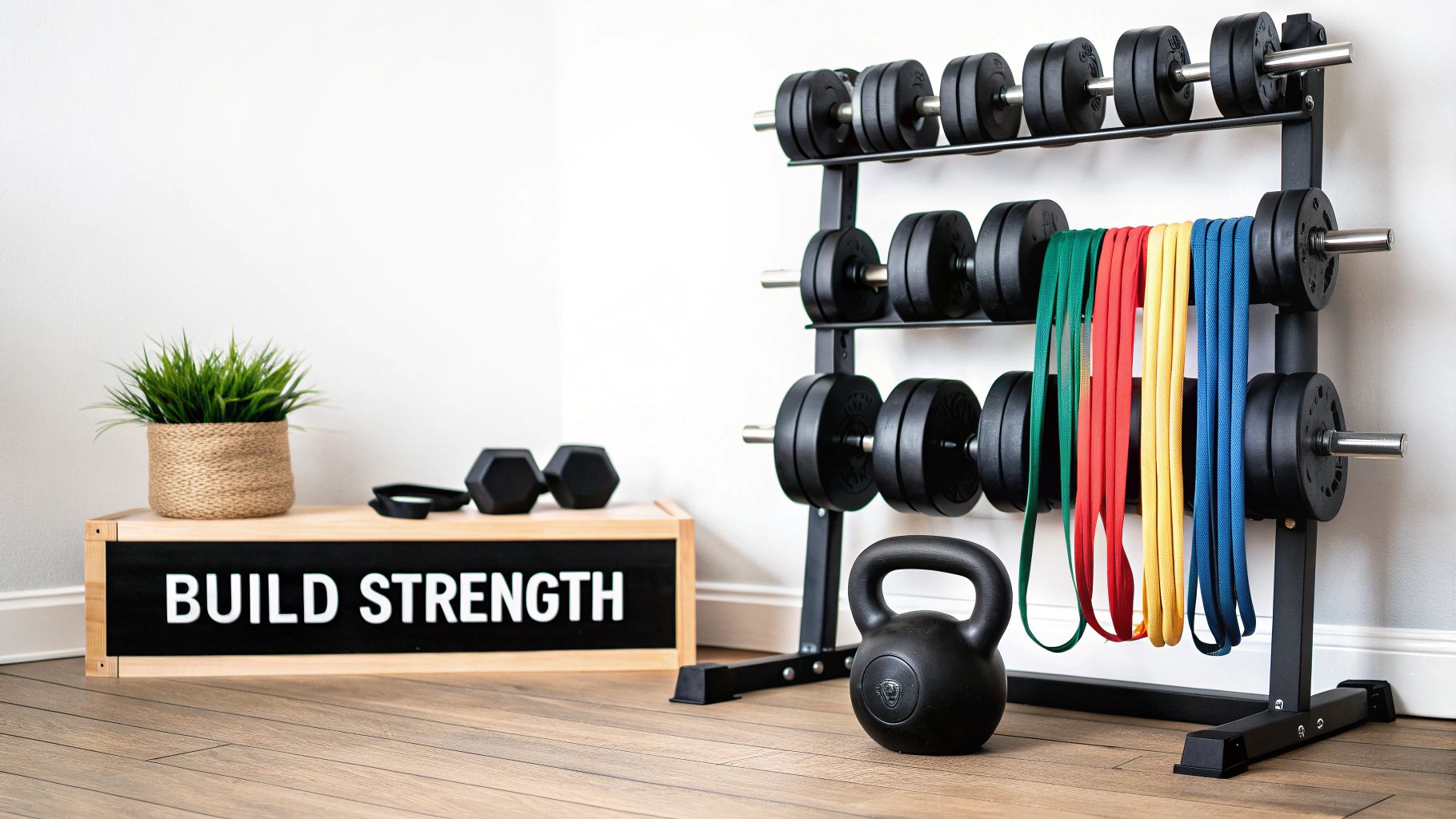
Think of dumbbells as your precision instruments. They're perfect for zeroing in on specific muscles with exercises like bicep curls or shoulder presses. Kettlebells, on the other hand, are built for explosive, full-body movements. Their odd shape creates an offset center of gravity, making them ideal for swings and snatches that get your heart pumping while building serious power. And barbells? They are your heavy hitters, letting you load up the plates for big compound lifts like squats and deadlifts to move the most weight possible.
Space-Saving Strength Solutions
Don't have a ton of room? That doesn't mean you have to give up on your strength goals. One of the best innovations for home fitness has to be adjustable dumbbells.
These things are genius. You get the versatility of a full dumbbell rack—sometimes with over 15 different weights—all packed into the space of a single pair. A quick click of a dial or slide of a pin, and you can go from light warm-ups to your heaviest sets in seconds.
To really open up your workout possibilities, pair them with a solid bench. It’s a game-changer, letting you do everything from incline presses to supported rows. You can see how a Multi-Functional Weight Bench for a Full Body Workout can easily become the heart of your strength routine.
The secret to consistent strength training at home is making it as convenient as possible. Space-saving gear like adjustable dumbbells removes the friction between wanting to work out and actually doing it.
Versatile and Affordable Strength Tools
You don’t need to drop a ton of cash to get strong. In fact, some of the best home workout gear is also the most affordable, proving you can get a killer workout on a budget.
Resistance bands are the perfect example. These simple stretchy bands deliver something called progressive resistance, meaning the tension gets heavier the more you stretch them. It’s a unique challenge that’s amazing for building muscle and protecting your joints. Plus, they're super light, portable, and great for hitting smaller stabilizing muscles that free weights can sometimes miss.
Suspension trainers are another fantastic, low-cost tool. All you need is your own body weight and a set of straps to knock out hundreds of exercises. They challenge your strength, balance, and core all at the same time. You can anchor them to a door, a ceiling beam, or even a tree outside. It just goes to show, a powerful workout is always within reach.
Exploring Smart and Connected Fitness
Technology is completely changing the game for at-home fitness. We've moved way beyond simple step counters and into a world of fully interactive experiences. The new wave of smart equipment—think connected bikes, AI-powered strength systems, and fitness mirrors—feels less like a machine and more like a personal trainer living in your home.
These high-tech tools offer something traditional gear just can’t: real-time feedback. Imagine a system that corrects your squat form mid-rep or a bike that automatically cranks up the resistance to match your instructor's cues. This level of personalized guidance used to be reserved for pricey one-on-one training sessions.
The Power of Interactive Coaching
One of the biggest draws of smart fitness is the live and on-demand classes. Instead of staring at a wall while you run, you can jump into a virtual class with a high-energy instructor and a whole community of people from around the globe.
That sense of community is surprisingly powerful. Leaderboards, social features, and shared goals create a motivating atmosphere that pushes you to show up and give it your all. Tracking your progress becomes seamless, too, with detailed metrics showing you exactly how far you’ve come. For even more granular data, a device like this Ultra GPS Smart Watch with built-in compass can monitor all your activity.
The Real Costs and Considerations
While the benefits are impressive, smart fitness often comes with a higher price tag. The initial cost of the equipment is one thing, but many platforms also require an ongoing monthly subscription to access their content libraries and live classes.
Is smart fitness worth the investment? It depends entirely on what motivates you. If you thrive on data, community, and guided instruction, it could be the key to unlocking your consistency. If you prefer a simpler, unplugged workout, traditional gear is more than enough.
You also have to think about the technical side. This gear relies on a stable internet connection and software that needs regular updates. Before you commit, it's always a good idea to read recent reviews and make sure the platform is reliable.
The growth here is undeniable. The home fitness market is exploding with tech advancements, with the global market size projected to jump from USD 19.98 billion in 2025 to USD 31.01 billion by 2029. That's an explosive 11.6% compound annual growth rate, highlighting just how popular these connected solutions are becoming. You can read the full research on the home fitness equipment market to see exactly where the industry is heading.
Your First Home Workouts with New Gear
You’ve unboxed your new equipment, and the motivation is high. So, what’s next? Having the best home workout gear is only half the battle—the other half is actually using it to get results.
To help you hit the ground running, we’ve put together three simple but seriously effective routines. Think of these as your launchpad. They're quick, easy to follow, and perfect for building confidence right from day one. Let’s get moving.
Full-Body Strength Routine
This workout is all about building a solid foundation. It hits all your major muscle groups using just a set of dumbbells or a few resistance bands. The goal here is efficiency and form.
Perform 3 circuits with as little rest as you can manage between exercises.
- Goblet Squats (10-12 reps): Grab one dumbbell and hold it vertically against your chest. If you're using bands, loop one just above your knees to add resistance.
- Push-Ups (As many as possible): The classic. Go from your toes if you can, or drop to your knees. Just keep that back straight!
- Dumbbell Rows (10 reps per arm): Hinge forward at your hips, keeping your back flat. Pull the dumbbell up towards your chest, squeezing your shoulder blade.
- Glute Bridges (15 reps): Lie on your back with your knees bent and feet flat on the floor. Drive through your heels to lift your hips toward the ceiling.
Need a visual? Check out our Full-Body Strength video on social media for a detailed tutorial. We break down every single movement to make sure you’re doing it safely and getting the most out of each rep.
High-Energy Cardio and Recovery
Ready to get that heart rate soaring? This quick circuit uses a jump rope and your own bodyweight to deliver a serious cardio punch in just a few minutes. Afterward, we’ll cool down with a simple flow to help your muscles relax and recover.
Cardio Circuit (3 rounds):
- Jump Rope: 60 seconds
- Jumping Jacks: 30 seconds
- High Knees: 30 seconds
- Rest: 60 seconds (you'll need it!)
Flexibility Flow (Hold each for 30 seconds):
- Foam Roll Quads: Grab your foam roller and slowly work it down the front of your thighs.
- Cat-Cow Stretch: Get on your hands and knees on a yoga mat, then alternate between arching and rounding your spine.
- Child's Pose: From all fours, sit back on your heels and stretch your arms forward, letting your head rest on the mat.
You can find the Cardio Circuit and Recovery Flow in action on our Instagram and TikTok. Following along with our trainers is a great way to stay fired up and find new routines!
Your Questions About Home Workout Gear Answered
Alright, let's tackle those lingering questions. Deciding on the right home workout gear can feel like a big commitment, but it doesn't have to be complicated. We've pulled together the most common things people ask to clear up any confusion and help you feel totally confident in your setup.
How Much Should I Expect to Spend on a Basic Home Gym Setup?
You can get a seriously effective home gym going for under $200. The trick is to start with a few versatile, low-cost pieces that deliver the most bang for your buck.
- Resistance Bands: A solid set will usually only set you back $20-$40.
- A Quality Yoga Mat: Expect to pay $25-$50 for a good one that won't fall apart.
- Adjustable Dumbbells: A starter pair can be found for around $70-$150.
This simple trio opens up a massive range of strength, cardio, and mobility exercises without breaking the bank. You can always add more specialized equipment later as you figure out what you love to do.
What Is the Single Most Versatile Piece of Home Workout Gear?
This is a tough one. For pure versatility, it’s a tight race between a set of adjustable dumbbells and a quality set of resistance bands. Honestly, they both bring something unique to the table.
Adjustable dumbbells are fantastic because they let you progressively add weight without needing a whole rack of equipment, which is perfect for strength training in smaller spaces. But you can't beat resistance bands for portability and affordability. They work for everything from toning and strength work to stretching and physical therapy, making them an incredible tool for just about any fitness level.
Do I Need a Dedicated Room for a Home Gym?
Absolutely not. A dedicated gym room is a nice-to-have, not a need-to-have. Some of the best and most-used home gyms are just a corner of a living room, bedroom, or garage.
The key is to choose compact, storable equipment that makes your workout accessible. If your gear is easy to pull out and put away, you're far more likely to stay consistent with your routine.
Think about items that can slide under a bed or fit into a closet, like resistance bands, a yoga mat, or even a foldable stationary bike. It's all about making it work for your space.
Ready to start building a home gym that works for you? Cool Brand Designs has put together a collection of high-quality, practical fitness gear to help you hit your goals. Take a look at our top picks and find exactly what you need to get moving.


